Tuesday, April 6, 2010

Moving onward and upward...


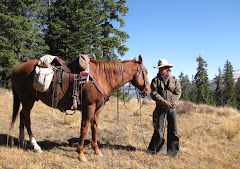
First foal of the season – born in lower ground.

Moving onward and upward…

Life is nothing if not an adventure, I once read.

I, for one, am ready for a new adventure! Perhaps, you ask, outfitting was not enough? Well, it was plenty fun. But my husband has done it for thirty years. He’s had enough. Do you blame him? He didn’t want to ride up the same trail one more time with a pack string and a line of riders following behind him, no matter how spectacular I still find that trail to be. Fair enough. What I find remarkable is his willingness to change, and in this case, it’s a mighty big change!

Horses, I remind him. I have to work with horses. And so, we will continue to do so. Just in a different location, and for a very different means...

On one hand here, we’ve become too comfortable. A bit of “been there, done that,” combined with years of building and setting up our home and ranch so nicely that now we feel a bit sinful living so well at such a young age (can I still call 43 young?).

On the other hand, it could never be comfortable enough. As in, I lost horses due to the altitude and soil bacterium. And not just any horse, like a good old horse that had a good long life. No, I lost foals. Foaling is the highlight of my year. How can I live where I can’t have foals?

And so we pack out bags, and our brand new (new to us, at least) horse trailer and head north!

North? Yes, way north! It’s cold up there, someone told me. Well guess what? It’s cold here in Colorado, if you live at 10,000 feet elevation! I understand where we’re going up there already has dry ground. Here we’re still tucked in under two feet of packed winter snow. Today didn’t even rise up to 30 degrees and the snow fell horizontally. So if you’re worried about our heading to a cold climate, well, I think we can handle the cold.

And so our adventures continue. In fact, I think they’re only just beginning. Every day is a new beginning, remember? We’re off to begin a great journey of which the horse will continue to be a part, or perhaps even a greater focus. Just you wait! Yes, I’m so very excited!

So much to do to make it happen. So much to learn once we begin. For now, no time to sit around and write about it. It’s time to begin it!

Leap and the net appears!

For now, I’m still weaving that net… but don’t be gone too long; I’ll be back soon to share the adventures with you.

Stay tuned for a link to our new site…

Saturday, March 27, 2010

At winter's end


Elsewhere, your thoughts, your pasture, your warm air may be turning to spring. Your trees may be swelling, budding, in bloom, or already leafing out. Your horses may have already shed, feet trimmed, and now are getting in shape for the season ahead.

Here our world remains white. Winter remains. I reflect back upon post from earlier this winter, originally posted on the High Mountain Muse site.

I know spring is coming, though it may be harder to see here. Our mare, Tres, the first of the season due to foal, has been led off the mountain into caring hands where we anticipate a new life, a healthy colt, soon, so very soon…

In the meanwhile, I share this with you about the world from which she just descended, the world in which we still remain.


The horses’ coats are thick and heavy. Shaggy, fuzzy horses. Wild beats to look at. Even their winter coats do not keep the cold from penetrating their skins, chilling them deep within.
Frost builds up on their eyelashes and at the base of their tail. Small opaque icicles form around their muzzles.

I wonder if they know this cold spell will not last but a day or two. Temperatures will warm. Mornings will return to around zero. A noticeable difference from twenty below zero, as we have this morning.

In the mornings the air is as still as the ice. Sometimes I think you can almost see the frozen water in the air.

In the afternoons, the wind blows strong and violent as the sun slides behind the slope of Ute Ridge. It is early, not even 4 o’clock as the sun silently slips away for the day, the signal which warns us to prepare for nighttime. I finish my outside chores as the thermometer’s figures drop before your eyes if you had nothing better to do than watch. Keeping busy keeps you warm.

The horses huddle in the wind. A mass of many, all with their rear ends to the wind. From one another, from the position of their hearty yet so fine and delicate bodies, they find simple protection from the elements. They remain out in the open. I wonder why they don’t seek the shelter of the sheds. Deep inside, they are still animals of the plains. They are still wild as that wind. More so in the winter, when they are allowed to be here, forced to be here.

Wild, or so very domesticated, as they have been for thousands of years, our companions, our partners, our beasts of burden, of transport, of war. They have changed the life of man. They have certainly changed my life.

Who says horses can not tell time? They are as punctual as I am. Usually more so. They watch in the direction from where they expect me to arrive, anticipating their next meal that they know will be… soon, so soon, never soon enough. Like so many sun dials if I were the sun. I suppose my presence, that which brings promise of hay, is nearly as welcome as the rising of the sun.

We feed heavy. Calories are heat. An apparent conversion. Extra hay and a concentrated pelleted feed. They endure, heads down, eyes not meeting with mine. Just surviving. They will eat. This will pass. They will make it through.

Only my little stallion seems to suffer. Born in California and raised in a protected stall, he seems to find this all so wrong. I think at times he is right. His coat is as thick as those born here, those who accept the cold blasts and biting winds without visible concern. It is an expected and tolerable part of life for them. As if they shrug their shoulders and acknowledge that which they can not change.

Saturday, March 20, 2010

The value of the wild

We are blessed to live adjacent to the Weminuche Wilderness. Yes, that’s Wilderness with a capital W. A designated location, almost a half a million acres of what we otherwise may find a more productive use for. There is little value in peace and solitude. Can you place a price tag on “wild?” What is the value of the wild, except something deep and dark within us all? Something we often prefer to overlook.

Out here, out this far, there are fewer willing to find this place, find that space within themselves. As outfitters, we see that business is less and less in the back country. Far away is even further. Being out of touch is out of mind. Uncomfortable is not a chosen state. So fewer come. Beyond the trailheads easy to the masses to access, there is a reduction of use, especially in use beyond a short day’s hike.

Why should we care? I once received the response, “Gee, great, more for me.” That’s not the answer I hoped to hear.

Why aren’t we out there enjoying the wild more? Why don’t we care? Have we forgotten what it feels like, and what it can do for us deep down inside, and what it really means in the big picture?
Us back country users/enjoyers are getting greyer, and the younger generations aren’t going out there. Why not? If we can blame someone, do we blame ourselves, the parents and elders, who don’t make the time to take the kids on a pack trip, a camping weekend, or even a long Sunday hike? If they aren’t given the chance to be out there, how will they learn to appreciate the wild? How will they ever know how incredible it feels, smells, sounds, looks? There are some things that can not be replaced by the TV, the Game Boy, and Instant Messenger. Are we teaching our kids to sit and listen to stories, to walk in nature, to stop and listen and look and feel the beauty of the world around them? Is it too late?

Years ago, I was lucky enough to have the opportunity to take small groups of kids from a summer camp out on pack trips. I truly believe each and every child who participated was touched in a way that would effect them forever – touched by nature, by wildlife, by the responsibility of caring for their horse and in turn, trusting the horse to care for them, by the camaraderie of such simple but true friendships that are built around camp fires and out gathering horses in the early morning dew. I wish more kids could have this experience. Children’s camp like that is usually limited in its scope and available only to an “elite few,” but as Forrest says, at least we had the chance to open this world up to those few.

Much of my outfitting work now is day rides with people who have never been on horse, or at least, never taught how to be on a horse. I am given the opportunity to share this with my guests, and then take them out to show them something even more: the mountains and trails and wild places all around us. Still, every time I take riders out, I am so excited when I return and tell Bob all about how wonderful this person did, how I watched him or her do so well with their horse, what a beautiful time I know they had, and most important, how special a day I was able to provide for them, what a world out there they got to experience that they didn’t know existed before that ride, or at least forgot, and needed this simple time in the saddle out there to remember. And yet, still, they remained so close to the comfort of the ranch, the road, the cabins. It is hard to venture far.

Less and less people know what it feels like. Being out in the wild just does something for a person. We touch the wild, and something wild within us stirs.

You know the old saying of “there is nothing better for the inside of a man than the outside of horse.” That’s a lot of it. But there’s more. There is nothing like waking in the morning to the crisp mountain air, and listening to the cow elk call her calf as you sit on the hillside and sip your coffee, to make you think about what really matters in this world. There is nothing like arriving at camp after a long day of hiking or in the saddle, and feel so at home, having “earned” your place relaxing by the campfire, to remind you of the simple pleasures in life. There’s nothing like seeing the stars out there, so far away, when you step away from the heat of the fire to feel your true place in this very big picture.

Nature is so important. And if we don’t use it, we could lose it. We will lose a part of ourselves if we forget or never know what it feels like. And we’ll risk losing the wild places. Will we then lose the wild part within us?


Man seems to feel that everything needs a purpose. If the purpose of the wilds is no longer valued for the irreplaceable goodness it provides for our body, mind and soul, then Man will probably put it to another use. Yes, our trails will be the first to go (we already have an ongoing struggle to keep them maintained). But then the wild places themselves may go – be sold off, sectioned off, a “better” use may be found.

I’m on my high horse here once again. OK, enough.


originally published February 2009 at highmountainmuse.com

Saturday, March 13, 2010

Some thoughts on learning horse talk

And where do we go from here?

Tom Dorrance is often quoted as having said, “Listen to the horse. Try to find out what the horse is trying to tell you.”

But I’d like to know, how do we know what the horse is telling us until we learn to speak their language? I suppose it is easier for those born into the world of horses. That’s a great place to begin. However, for those who were not, those that sought horses on their own, and even (oh my!) not until adulthood, learning the language is more difficult. Just like learning a second language, it is of course possible, but how much easier when we are raised in a bi-lingual household!

That, my friend, is what makes a good teacher. One who can point out not only what the horse is saying, for those of us uncertain of the language, but also explain the language to us. Translate, if you please. And in time, we thus can learn to understand what the horse is saying.

It's not a matter of whispering. It's just learning to talk the horse's language. Our goal is to learn the language.

As Wendy Murdoch points out in her book, “Simplify Your Riding” (copyright 2004 by Wendy Murdoch), “The adage ‘the horse is your teacher’ is only useful if you understand what the horse is teaching. It is difficult to ‘let the horse teach you’ if you don’t know what the lesson is.”

I’m also pretty interested in Wendy’s point of view on “modern methods” of teaching in which the student/teacher/horse interact in a positive manner to achieve positive results, as opposed to “traditional methods of teaching people how to ride (which) include repetition, exhaustion, negative reinforcement, and domination…Yelling and screaming at students only drives them further into the undesirable pattern because when stressed we simply react, we don’t learn.”

I’d like to learn. I’ll choose my teachers accordingly.

Likewise, when I’m here to teach, I am learning to be a better teacher using the positive reinforcement, striving to increase both knowledge and confidence in my riders, and hopefully enjoying the process together!
Bill Dorrance stated with great importance in a special addition to his book, “True Horsemanship Through Feel” (copyright 2007 and 1999 by Bill Dorrance and Leslie Desmond), “Horsemanship through feel is handed down from one friend to another.”
I’m looking for that friend. A good teacher should be that friend, or at least, assume the role of “friend” when working with you, teaching you the horses’ language that he or she may already have figured out (or, more than likely, been taught) pretty well.
Finding that teacher, or friend, is not as easy as I had hoped...

I intend to always be learning, to always be open to new ideas, and by golly, I’ll be one lucky lady if I can keep up with working with my horses long enough to accomplish half the goals I hope to achieve in terms of horsemanship.

I will never live long enough to do it all, master all, and certainly not know it all. I know of no one who has lived that long. What I can do is enjoy learning and continue trying. What more can we each ask for?

Time to get off my high horse…

I end with a quote I read recently, though I do not know its source:

"If you always do what you always did, you'll always get what you always got."

Saturday, March 6, 2010

Why do we go there?


Why do we go there?
Out there with our horses?

I was giving some thought to this question, considering the feeling of being out there at camp with our horses in the high country. I lost myself in the reverie of sitting in the warm sun, my back against a large, smooth rock with a book in hand as my horses graze contentedly in the tall grass around me at the end of a long day in the saddle. Together, dreamily, we watch the shadow of the sun slowly falling behind the mountain, inching its way across the valley towards us.

It is far away now, that picture, as our world is white and frozen, our horses still shaggy, and morning temperatures still sinking below zero. But the feeling is very close. It is inside me, something I cherish, something I will always have with me.

I’ve discussed the “how to” of horse camping quite often and in details here, but more important to me, I consider the “why.”

The “how” enables us. The “why” drives us.

That “why” is a clear picture to me. It is the picture of traversing a narrow cliff on a surefooted horse and descending the rocky slope into a lush green valley, my horse and I, worn and tired but elated to be there. We pause, look about to notice the elk scatter before us under the shadows of red tail hawk circling high above. Then my horse lowers his head to taste the high mountain grass, and I dig into my saddle bag to pull out a snack. We remain there a moment before moving on. We savor the mountain together.

“Why” is much more than a picture. “Why” is a feeling. It is the feeling of camaraderie, of connection with our horses. We remain with them, partners, a team. Out there, we don’t leave them behind, put them back in the barn or turn them out to pasture until we need them next. We stick together, work together, get tired together, rest together, stop and enjoy the view together. We face challenges together not so different than the knight in shining armor heading into battle on his trusty steed. There is the essential element of trust. Neither of us would be there if not for the other. Together, we can conquer. The mountain. Our fears.

We return a different team, together, closer, more compassionate, more efficient, clearer in our communication and understanding with and of each other. And don’t tell me the horse doesn’t see that view. And feel the fresh air and dewy grass and comfort of the woods at night and warmth of the sun in the early morning and the coolness of the clear mountain stream, and the gentleness of my cheek as I rest my head across the low of his bare back in the evening sun as he stands out in the open field, very much at home with our horse and human herd, together in these wild open mountains.

They feel it too. I’ve had my horses run jubilantly, kicking up their heels in an uncontained joy if allowed, when then know they are almost to “their” favorite camp.

For most of us, horses are no longer a means to an end, a mode of transportation. Those that still treat their horses that way get what they ask for.

The trip is but the excuse. An excuse to be with our horses in a more intimate environment than anything we can find or create back home, at the barn or in the arena. Being out there, together. It’s as much, perhaps more, about the relationship with horse than it is about the journey. The horse therefore becomes the journey, more so than the places we pass through and the camp we arrive at together.

That is why we go there. To be out there with them. Out there with our horses. Enjoying the mountain, enjoying our horses, building trust, learning a quiet communication, creating a camaraderie and building companionship.

And of course, all along the way out there we can share the view and the wideness of our hearts and minds as we stop and stare at it... together.

Saturday, February 27, 2010

Pass it on


I was not raised around horses. Then, I did not know anyone who was. Even fewer have that opportunity today.

Just as this did not deter me from finding and creating a life with horses, it also need not be the demise of the horse industry. Perhaps it is just time to readjust our way of looking at the horse world.

If the numbers are fewer for those of us who live and work with horses, perhaps our responsibility for sharing our knowledge and experience is now greater. We can reach more people, teach more people, and share our life – and horses – with more, especially the younger generation who just might get the same “horse crazy” bug that many of us found ourselves with.

In fact, the sharing of our horse understanding, passions and skills need not be limited to the young. There are plenty of excellent and dedicated horsepersons – both professionals and enthusiasts – that were not “exposed” to horses until later in life. But they would never have turned to the world of horses if they never had the opportunity, the simple introduction.

That’s our job. It should be the job of all us horsemen and women to be not only ambassadors of the sport, but representatives for the horse. All we need to do is open the window to this world a little bit and let the fresh breeze flow through.

It is no longer easy. For most, horses are not readily accessible, just down the road, and part of the extended family. Demographics show our society as a whole is now further removed from the rural lifestyle – and the ensuing knowledge and experience with horses that this could allow. Horses are no longer a way of life, or even a part of life, for most families. Two generations ago, many folks still had or knew families living and working on farms with horses. With each generation, these numbers dwindle. Thus the opportunities for even the extended family and friends to “get to know” horses – say, the young suburban family coming for the weekend to visit the grandfolks who are still managing the old farm – are fewer and fewer.

But not gone. The opportunities are still there. We may just have to work a little harder to find them. And for those of us with horses, working with horses, we may just have to work a little harder to share them.

Now, I don’t want to share my horses, per say. They are not only my business and my work partners, but they are a part of my family. But what I can do is share my knowledge, share my experiences, and help pass on the passion I have for my horses, even if it means taking a friend out to the pasture to just walk by and talk to the horses, or a child out to groom and learn to pick a hoof.

It is up to those of us who still do live and work with horses to share our knowledge and pass it on. Our responsibility to teach, to share, to pass on the skills, the traditions, the ethics, manners, dedication and hard work. As an outfitter, horses have also been a part of my job. At times I am as awkward charging for my services and lesson as I often feel charging for cabin rentals when I feel like folks are here as my guests. But horses aren’t free, and they sure aren’t cheap. Feed, supplements, vet bills, shoeing expenses, transportation, insurance, tack and tools, etc., etc., etc. So yes, like it or not, sometime we do have to charge… it is a practicality we can not avoid. But it is not one that should limit us in our ability to reach others, just a minor detail.

The largest burden here seems to fall on the grandparents. And for grandfolks with horses, I’ve been told, it is not such a tough part of the job! Probably more like of the best. Sharing horses with grandkids.

Well, I don’t have grandkids yet, but I do have a bunch of young nieces and nephews. These are my surrogate grandkids for now, and the focus of my “passing it on.”

We share and show what we can, when we can. Sometimes, here, with us, will be the child’s only opportunity to glimpse into another world and take a bite, and hopefully, as is with a small but important percentage, taste enough to be hooked, to get the horse fever.

It’s not just horses; it’s the whole rural lifestyle. Camping, campfires, baking bread, gathering eggs, shoveling manure. It’s a package deal, and few kids don’t enjoy at least parts of it. They may not choose to live it, but they can love it. They will always remember this, and for those lucky enough to have had the chance to be exposed to our lifestyle and our horses, the memories and skills and understanding will remain with them forever.

Take a kid riding. Take a friend riding. Have someone share in the chores, the care, the companionship. Bring a friend to a horse show, on a trail ride, to a lesson. It can no longer be about “me and my horse.” Perhaps it’s time we began to consider it is more about “us and our horses.” All of us. So, let’s share our passion and enthusiasm for horses and riding. Let’s pass it on.

Saturday, February 20, 2010

Confidence and Knowledge


We begin in ignorance. Without knowing how little we know, we have complete confidence. A good example of “ignorance is bliss.” A great place to be, but fragile, it does not last. Reality sets in.

We begin to learn. We start to see how little we know, how little control we have, how lost we are. We can get hurt, and perhaps we do. And something happens to that confidence. A dose of reality pops our bubble of bliss. We find ourselves feeling exposed, unprotected…. And scared.

Confidence, or lack there of, is something I deal with regularly in both my riders and myself. In my riders, I can asses their level of horsemanship often based on their confidence. The complete beginner will come to the riding experience full of excitement, and without fear. They have nothing to fear yet. One who has spent some time, unfortunately this can be just one bad ride, will come in fear. They have minimal knowledge, but a healthy dose of fear. Those who have spent plenty of time riding, and time studying the horse, return to self-assurance, though one at this level still must be warned of overconfidence – the false sense of knowing enough that can block us from realizing how much we still have to learn, or prevent us from being open to learning more. This is the "good enough, it works for me" syndrome. Then the highest levels of horsemen I observe, and strive to be like. I have a long ways to go. They come in a quiet, confident air of humility. They have an abundance of knowledge and understanding, but part of that knowledge is the fact that they know there is always more to learn.

So, how do we achieve confidence?

Let me tell you, I have to work on this one regularly in everything I do. I was not born with the comfortable ego of many. Mine is frail and wavering. For years, this bothered me. I felt inferior because of it. But what I have found was that this very trait, insecurity, is what is ultimately allowing me to grow into a good horseman.

The only way I have found one can overcome fear and insecurity is through knowledge. Confidence, and I don’t mean a false sense of over inflated ego, but a true sense of quiet understanding, comes from one thing: knowledge. The more knowledge we have, the more our fears and insecurities are replaced by facts. We learn to understand, and are able to act with positive assurance because we know what works and why.

Mind you, since the best horsemen I know are always learning and growing, we must remain with an open mind, and constantly adjust, grow, and expand this base of knowledge.
And the process of replacing fear with knowledge is an enjoyable journey. We can’t learn if we aren’t willing to try. What we can do is enjoy learning. It means being with our horse, growing with our horse, and growing in our hearts and minds.

We do learn by listening. (Likewise do we miss out when we don’t listen.) One great horseman said, “Listen to the horse. He’ll tell you when you find the right answer.” For those of us desperately seeking right answers but without direct human guidance (no mentor, teacher, trainer, etc.), the horse ultimately is our best educator, and yes, will be the one to let us know when we by chance stumble on the right way of doing things.

But how do we know where to begin, what to try first? What action to take to give the horse the chance of approval or disapproval, acceptance or suggestion or revision? We are not born with this knowledge. We must strive to ascertain and achieve.

I believe a good trainer, teacher or mentor would be the best first step. They have already a base of information to share. But be warned. We can not learn it all from one person. All we learn is their way. There are many other ways. Be open. Take what knowledge you can, what works for your and your horse then and there, and be willing to move on, to try new things, to listen to others. (This is, or should be, what the best of trainers and teacher have done.) No well rounded education comes from one book.

Without a trainer/teacher/mentor, as I have been, how do we learn? Where do we begin? Clinics are one possibility, but I have seen more damage done for the insecure (not uncommonly due in part to the rudeness of the auditors than anything else). Clinics are not for everyone. If you choose this route, know what you are getting into. Auditors are a pet peeve of mine, folks who in the safety of the stands feel they are in a position to throw insults and advice at will. No one, and I mean no one, paid to learn from one not brave enough to even participate. Learn to ignore these folks and see them for what they are.

For me, books, articles and DVDs have been the best teacher. They are available even way up here on my mountain. Who do I watch and read? Everyone! Every book, magazine and DVD I can afford each year written by any horseperson of any discipline on any level. If I can not find at least one thing to learn from each, chances are I am not really watching/listening/reading.

Everyone, every experience, and every horse present an opportunity for learning if our minds are open enough to absorb. It is only when we look at life with a closed mind (“I already know that…”) that we miss the obvious lessons.

So, I strive to learn more with every encounter, every ride, every book and every DVD. And with each small piece, every tiny tidbit of information that I absorb, I find a little trace of insecurity is magically replaced with an equal amount of confidence.

If I do not seek knowledge, my insecurities have every right to remain. But the equation is simple. Knowledge brings confidence. A real, solid true confidence, like a foundation that can forever be build upon.

I read recently something like this:

We must do something we have never done before
To get where we have never been before

We must try new methods if we wish to achieve new results.

I have yet to find a horseman who could not learn more.

An open mind is essential for the growth of the rider, the understanding of the horse, the relation of the student/teacher, and an appreciation for the fullness and beauty of life.

Saturday, February 13, 2010

Sitting

I’m lucky to have the opportunity to work with beginner riders. Each new person is a new opportunity for me to improve not only my teaching methods, but my own riding skills and horsemanship. Not to mention my communication skills with my riders, which has by necessity improved tremendously over the years. At least as far as lessons are concerned. I suppose I am not the only horseman to feel I communicate better with the four leggeds than the two.

I’m learning one of the most important things I can teach – and one I overlooked for years, considering it unnecessary and taking for granted that it would just be done.

Sitting.

Sounds simple, doesn’t it?

I have found it to be one of most complicated lessons to teach, to put into words. And yet, one of the most essential, basic skills, and the perfect starting point for any rider.

Once we learn to sit, we can learn to ride.
When we sit well, we can enjoy the ride, and the horse can too.

A proper seat is taught from day one in English lessons, at least it was back in the day (we don’t need to count how many days ago) when I was taking English lessons. But for the Western rider, is it not considered until more advanced levels, and sometimes I question, if at all.

Why not?
I’m learning to bring it back to the beginning, and introducing “the seat” to my beginner riders, to help them sit comfortably and solidly on the horse from day one.

Trouble tends to be with the more experienced riders. As you’ve all seen, often the more time someone has spent riding, the more set in their ways they may be, or the more convinced they are of their way being the best way. Of course. It is easier to stick to the old way than having to learn something completely new.

Sitting does not need to be new. A good seat seems obvious, or at least, when you have it right, is hugely apparent. Likewise, when you have it wrong…

We start with breathing. How many beginner riders (or advanced riders, facing any challenge –from riding along a steep drop-off to concentrating on a new skill) hold their breath?

So we start by breathing. We remind the rider to breath. And then, with each breath, the air is taken in deeper – no longer shallow and tight in the chest, but deeper, fuller, down into the diaphragm. You can see the rider up there on the horse. When that first deep breath is taken in and then slowly released out, somehow, suddenly, they are now sitting deeper on the horse.

And yes, a deeper seat is a safer seat, a more comfortable seat, for both rider and horse.

I love to see this instant transformation. Out on trail rides, I can remind the rider of the same when I notice them perched forward in tension, already half way out of the saddle. All it would take is one quick spook of the horse to send that rider flying out and down. We remind them to breath (yes, we all need to be reminded to breath sometimes!) and there they go, settling back in, solidly in the saddle.

For myself, I must remind myself regularly as well. In any tense situation - and for any trail rider, these can come suddenly, without notice, around any corner – my common reaction is to tighten up, rise out of the saddle, lean slightly forward, and hold my breath. I catch myself doing this regularly, and remind myself to sit back. In a tense situation, the last thing my horse needs is to feel that obvious tension in me. Better for him (and therefore, for me), if I lower my energy, breath more deeply, and sit back in the saddle in times of stress. This not only calms me down, but it calms my horse down. It allows him more confidence in my leadership when he needs it most.

So, we start to learn to sit by breathing. Then we learn to move with the horse, sitting soundly with the motion below us. Again, this is commonly taught in English riding, but the Western rider is usually not taught at all, or else taught an exaggerated form of movement, an over abundance of “life” in the rider, with the rider pumping the horse beneath him to encourage each step. This translates to a great deal of constant rocking and movement in the saddle. After a couple hours – or even all day – in the saddle – that would be not only tiring for the rider, but exhausting for the horse.

Give the horse a break. Consider his back, his comfort. Become conscious of your movements. There is a pretty solid line you will find between the over-abundant rocking form of riding, and that which keeps the rider tensely perched atop the saddle, never feeling the movement below. I strive to find and ride that line, and encourage my riders to do the same.

I believe this starts with breathing. If we settle solidly into the saddle, or better yet for learning, directly on to the horses back, we can learn to feel his movements. We can learn our most solid position and see how little motion it takes from us to allow the horses freedom of movement. Consider the leverage involved with the rider atop the horse. Due to the fact that we rise up several feet from the middle of the horses back, each of our movements creates a need for shifting weight, compensation, on the part of the horse.

When we begin to see how little motion we need to allow the horse the freedom of his own movements, we begin to allow ourselves to gently shift with the horse, and allow our horse to move with greater ease. We need not encourage and pump his every movement beneath our hips with an exaggeration of movement and effort that the horse then has to adjust his own movements to compensate for the movement of the rider. Instead, we strive to find harmony with horse and his movements. We allow the horse to move, and flow with his movements. The more subtle our movements become, the more the horse can move with ease and grace and fluidity.

Several teachers suggest “playing” horse to learn such feelings. This is a great lesson to try in order to learn first hand what the horse is feeling. Start by “being” the horse. Kneel on the floor on your hands and knees, and have a friend play “rider.” Start by feeling that person gently shift with your movements. Now, ask the “rider” to tighten, tense up, and lean forward. Then ask the “rider” to exaggerate her movements, bring that abundance of life in their seat. Feel the tension and stress this creates. Pretty annoying and uncomfortable, isn’t it?

This motion is great for teaching, both horse and rider, the initial feel. But once that feel is learned, let it go, stop nagging, and allow the horse to move on his own. Movement is his job, not something I have to constantly work at by “driving” him with my own movements. Instead, I consider getting out of his way, sitting solidly, and helping the horse do the job he is most capable of doing with the least amount of interference from me as the rider.

Size is not important – I have seen excellent riders be very tall, very wide, and very small. The key is moving your body, whatever the size and shape, with horse, in harmony with the horse. Start by sitting, then by breathing. Then consider sinking in with open hips onto the horses back. Next I urge the rider to sit tall, be bigger with every breath, remaining centered. I suggest they feel one string coming up from the top and back of their spine, lifting and straightening them. Then they feel a second string dropping from their ears, through their shoulders, down past their elbow, their hips, their heels, and dropping all the way to the ground, to the solid substance beneath them.

This is the beginning of sitting, of what grounds the rider in the saddle, keeps them straight, gives them contact with and feel for the horse. This is what I try to explain to my beginner riders. Likewise, this is what I work on with myself every ride, every time.

Saturday, February 6, 2010

The ethics of breeding


Without wasting time softening the facts and candy coating the bitter pill, I’m just going to go out and say it outright: The horse market is in bad shape. Sales are down. Registrations are down. Prices are plummeting. Think what you want about horse slaughter, it has had an impact on the horse market, along with the recessive economy and the decreasing and aging horse community.

There, I said it.

Now, what am I going to do about it?

I am a small time horse breeder. We buy, train and sell, and breed and raise our own. We love horses and have enjoyed the opportunity to “share” our talents and our stock.

Now we find ourselves having a hard time trying to sell good, solid and sound pleasure/trail horses for nearly give-away prices. We waste our time. Or rather, our time is wasted…

I’m picky. I don’t want our horses going to anything but a good home. I want them to be loved. Yes, I do. Otherwise, I’d just assume keep the horse in my care and wait to find a really good home, a really good relationship for that horse. They are like children. We care for them and work with them to teach them, and then send them on their way. We want the best for them. I imagine many horse trainers and traders feel the same.

Last years colts are sold, and I am thrilled with their new and future homes. Now we have three on the way this summer. Then what? Time to think this one through. Think it through now, before letting my mares run with the stallion again (because bred mares are easier to keep, and allowing the stud to run with the mares keeps him happier, too).

Lots to think about. I consider the horse market, the horse industry, and the management of my own herd. I don’t have easy answers. What I want and what I should do may not be the same thing here.

Really now, do I keep my stallion at stud just for the fun of it (and indeed he his a "fun" riding horse) because I don’t know if I should use him for breeding this season. Or next. How long will it take for the horse market to bounce back? Or will it?

I don’t see it happening right away. I don’t see it happening any time soon. Do I continue to add to the over abundance of horses out there, and possibly have one I raised and trained be one of those “unwanted?” Small time breeder that I am, I’d rather blame the big guys and wonder why the ‘ranch horse’ farms are still breeding 20, 50, 100 mares every year when I’m questioning my responsibility of breeding just a handful.

But you know, they say if you want a change, start with yourself. So as a small breeder, what do I do? Stop breeding?

Selfishly, I love it. I don’t do it for the money; I do it for my love of the horses. I once read, “A year without a foal is a very bad year…” I agree.

But what about my responsibility to the horses and the industry? Do I allow my stallion to breed, even just one? Or do I (gulp) have him gelded and make life easier?

I’ve never been into “easy.” I always love a challenge, which is why I purchased the stud in the first place. But I also consider responsibility. And I just don’t know.

Perhaps I can keep him out of trouble for a few years until the market picks up… if it picks up…

Oh, what to do???

Saturday, January 30, 2010

Mid winter thoughts on horsemanship


We find ourselves now in the deepest hour of winter, the farthest point from riding seasons, the one passed, the one anticipated.

Though thoughts of horses never cease. Likewise the care is a steady constant, despite the weather, the season, the schedule, the moods.

In this season, we are reminded that there is so much more to horses than riding. We see only an incomplete picture if we merely look at our horses and our horsemanship in terms of time riding. What we do on the ground matters – and I’m referring to much more than “groundwork” here. Or could we extend the term “groundwork” to include all interactions between horse and human? Perhaps in doing so, we learn to look at each simple interaction with new interest and value – each as an opportunity to discover and grow, for both horse and human.

Often it is through our littlest interactions that we both learn and teach the most. Think about it… what happens between us and our horse(s) during times of feeding, grooming, trimming, leading, handling, care of body and mind – both of which may need extra tending to during the slow and seemingly meaningless cold days of standing around waiting which winter often is. For us, in every interaction, there presents opportunities of gaining knowledge and growing through short and simple lessons of understanding horse behavior, subtle communication, body language, herd psychology, manners, boundaries, respect of human, love of human. Yes, I always seek this latter part as well. Love not because I have treats in my pocket (which I do not, nor do I consider the want of treats to be love) but because I am their fair but firm leader, caregiver, direction giver, provider. A gentle rub on their neck rewards them greater than a pocket full of goodies. At least, this is what I strive for…

Still, this is perhaps less a time of hands on learning as it is one of simple observation. The end result, if we are conscious and consistent, is of equal growth. Our minds must grow as our bodies do; skills of our mind must increase as do skills of our muscles. The two must balance each other. Once again, we strive for balance. How often that word is a part of our horsemanship language.

Last week, I received a note from my 10-year old niece, Alex, describing an opportunity she and her group of Girl Scouts recently had with horses. I had the honor of observing this young lady handle some of my horses almost a year ago, especially in helping me care for my broodmare, Tres, and her newborn, Artemis. I watched as Alex could with a most natural confidence and ease lead the mare through the snow with baby following close behind. I watched as my mare, who I have spent innumerable hours observing and understanding, followed Alex with lightness, interest and a respectful distance. Tres was soft, easy, observant and patient. An interesting combination of regard, sensativity and care.


Alex writes of her observation during her experience last week how the horses seemed comfortable with her: “I don't exactly know why. Maybe cuz I'm not afraid of them?? The world may never know.”


Many of us think we might know, and I suppose Alex does to a degree as well. First of all, because she’s right: she is not afraid. Second, because she also is not overwhelmingly bossy and aggressive. Only a fine balance of caring and confident. Something that at even at her young age comes quiet naturally to her, something that many are still struggling with. It is beautiful to see. The horses see it. They are not easily fooled.

I responded, “You know, I think with horses, they have a good ability to sense people. You can’t fake it with a horse. They see only what is real before them. And what they are most comfortable with in humans seems to be an interesting balance of confidence, understanding, and leadership (without any aggression or bossiness). They don’t need words like people, and they are not snuggly like puppies (though they can learn to tolerate this). They read body language, and seek being around a fair, strong, clear personality. They look for people they can be safe with, without being frightened, or feeling they have to be the leaders. Some humans are terribly wimpy, yes, perhaps because of fear, and that’s hard on a horse too. Horses are not aggressive. They prefer not to lead. You have that all quite naturally. For those of us who love horses, it’s beautiful to see.”

Alex shared this insight as well, which I thought many of us can well relate to: “Horses, to me, are kinda like detectors for emotions. When you're around them, they get scared if you are, or happy if you are.”


We will not become better horsemen simply by riding alone. Nor of course, would improve if we only did the thinking – growth requires a balance of both thinking and doing. Winter is the time for me to think: to observe, contemplate, and read and learn the theory, the theory I will then put into practice when the snow clears and I find dry dirt beneath the horses hooves. Many months away.