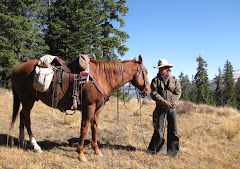
Showing posts with label Floyd's horse stories: Horses I Have Known. Show all posts

Monday, August 24, 2009

Floyd's Horse Stories: The work horses on the ranch


When I was a little kid, we had one big old tractor on the ranch that had big steel wheels. It was used to pull the plow and to power the thrasher machine. All the other tasks were accomplished with horses. We had about 20 head of horses on the ranch most of the time. That was just the mature horses we relied on for work, not including the mares and colts.

Every year we had from 2-4 colts. Our stud was a big draft horse. Back then, we didn’t put emphasis on specific breeds of the horses. The heavier or draft breeds were primarily work horses, and the lighter breeds primarily for riding. I’ve told you about our mare, Nellie, before (
see link). She’s the one the four of us boys learned to ride on, and who I first rode to school on. Over the years, she had probably six colts.

I’ve also told you a little bit about Ginger (
see link), the first horse that was really mine. I got Ginger when I was 8. He was about 14 hands, a pretty little sorrel gelding with light mane and tail. I thought he was the best looking horse I ever saw. I could entertain the visiting relatives from back east because Ginger would rear up and walk on his hind feet. That was sure to impress them.

At any given time, we had about 5or 6 saddle horses. Dad’s horse was a big sorrel with a star on his forehead called Tony. Dad used him during the summer to irrigate off of. He would ride the horse out into the meadows, which would be all flooded. Dad would step off Tony, drop the reins, take a board out of the head gate or use his shovel to fix a ditch, and Tony would stand there grazing until Dad was done and ready to move on. I would go with him, riding Nellie. Most of what I recall was that the mosquitoes would just about eat us alive.

Now, my Uncle Bill had a horse called Skeeter, and she was a big black mare that also was a very good cow horse and had one very good trait, one very special talent. When we was out checking the cattle, if a calf got across the fence and there wasn’t a gait close by to ride through, that Skeeter would jump the fence, bring the calf back in, and jump back to my Uncle Bill. Pretty amazing. I saw it myself at least two or three times. Uncle Bill would get off the horse; she’d jump that fence, chase the calf back through a hole in the fence, then jump back over and wait for Uncle Bill. You see, he bought that horse from a guy he met at the Stampede fair who was performing a trick act where that Skeeter would jump over convertibles. Well, my folks invited the guy out to the ranch after the show. The guy probably had a hard luck story, but I never heard it all. All I remember was that he was going to quit the circuit for some reason, and told us he was going to come back for his horse, but never came back, so Uncle Bill ended up with her. Well, that Skeeter didn’t have to do any more convertible jumping, but her talents sure came in handy on the ranch

As for the work horses, they’d have their hands full throughout the year, and we relied on them for a variety of jobs. When we were putting up hay, there would be about 14 teams in the field. Besides our own teams, my folks rented horses. Usually the driver and the team would come together; many of them local folks.

So, the full crew during haying involved about 14 teams. The big, heavy work horses were on the mowing machines. There were 5 horse drawn mowers. This was the hardest job on the horses because the sickle is driven by power off the wheels, but the sickle bar was off to the side. The side pull created by the sickle bar would wear on the horse’s neck with the side dragging all the time.

The next hardest job, for which we usually had four teams on, was the buck rakes. These gathered the hay and moved it into the stacker. The stacker team, whose job it was to pile the hay on the stack, had to be a really good team. Not only was the load of hay heavy but the team had to stop at exactly the right time to stack the pile just so. A good team and driver could place the hay either in front or back of the stack, and make the job of the men on the stack that much easier. Each pile would be kept nice and square with a rounded top.

Then, there were five teams on the sulky or dump rakes. These were usually lighter weight or smaller horses because it didn’t require the power to pull that many of the other jobs did. One team I particularly remember were a set of big bay mares we called Mini and Mandy. They were the stacker team during haying, the feed team during the winter, and when they were feeding cattle, why they would pull in beside the hay stacks, while the hay was forked onto the wagons, then pull out into the herd of cattle. The driver could tie the reins around the post on the wagon as the team would drive out, make a circle, and be back when the hay was unloaded. Early auto pilot.

We had two hay wagons, one that fed the cattle, one that fed the sheep. All winter long. 300 head cows would be fed. That required 3 loads of hay. The same was needed also for the sheep. So, both wagons would leave out soon after sun up, and wouldn’t be done until 2. On Saturday, they fed double, so it was an all day ordeal. But then Sunday was a day of rest.

The same horses were used for the farming operation, for disking and harrowing, planting and pulling the binder (a machine which cut the hay and put it in into bundles), then pulled the bundle wagons that hauled grain to the thrashing machine. The thrasher made a big straw pile as it threw straw out the back end, and grain out the side to a little box wagon.

When we were haying, you were expected to have your team harnessed and ready to head to the field at 7 am. Everyone took one hour off for lunch, during which time the women folk brought a hot meal out the hay field. The teams were unhooked and tied to the fence or the equipment, and given a fork full of hay for their own lunch while the people ate. At 1 o’clock, the teams were hitched back up, and the whole crew worked on the field to 6. After that, those of us who drove rakes still had to unhook the rake and ride the horse back to the barn. The mowers were the only ones who rode the equipment back in, as they had to change the sickles and grease the moving parts regularly.

When it was time to break the work colts, we took the big stud horse, and teamed him up with a new horse. We’d then hook the two of them up to the breaking sled, which was just a wooden sled with a tongue. On top of the sled, we’d pile sacks of sand for added weight. Well, no doubt that stud knew what he was doing, and he let the new horse run away and pull the whole weight of it. As you can guess, it wasn’t long before the new horse learned to let the stud take on his half of the work. And if they wouldn’t pull their half, he’d pull the sled right up into their heels to keep them going.

We’d drive them up the lane, turn around as the stud would push the young horse around, and drive them back. And do it again two days later. That’s about all it took with these horses. That stud was the teacher really.

There was a lot of work for the horses, and a lot of work for us all. Three meals a day were served for the crew. The crew included our family of 7, then my grandparents, Uncle Bill, the two maiden aunts, Clara and Amelia, and somewhere between 6 and 12 helpers. There were three men that were our regular help, who lived with their families nearby but would join for the noon meal. But throughout the year, for sheep shearing in the spring, haying in summer and thrashing in the fall, there would be more hired hands to help, and to feed. For most of the crew, there was a bunk house over the shop. They’d bring their own bedrolls, and sleep on an old army cot. Before meals, they washed up in the basement in my grandpa’s house.

Providing regular meals for all these people was a lot of work for the women folks, but that’s another story…
Story by Floyd Getz, Photos from the Getz family archives.

Saturday, June 20, 2009

Floyd's Horse Stories: Taking the sheep to the summer range


Soon after the ewes lambed out on the Ranch, and the lambs grew to be about 3 weeks old, we docked and branded and then took small bands of 150 or so pair at a time to the foot hills.

During the summer, we were permitted a total of 1200 adult sheep and their lambs on Forest Service lands. But during the latter part of May and into June, we’d drive the flock up to pasture in the foothills above the Ranch, taking the ewes and lambs up in the small bands as soon the lambs grew big enough to travel.

It was about a 6 mile trip up to the foothill pasture from the Ranch. And it was always on a Saturday when the drive took place. Funny, that’s the day when us kids (my brother, Melvin, and I) would be home from school and could take the sheep up... We did this on foot, driving the sheep slowly along for about 4-5 hours, followed later in the day by Dad, who would meet us up there in the pick up and bring us back down to the Ranch.

The first time I went up, the sheep herder went with us. That’s how we learned the way. But the sheep pretty much knew where to go in the foothills. The old ones would teach the new ones, and they would slowly move off in the right direction, urged on by the promise of greener grass. The only challenge here was keeping the little lambs moving along. They’d get tired and want to call it quits. We used to make rattles by taking a half gallon can with a handful of rocks inside, hammer the top together, drive a nail through to make hole, thread a piece of wire thru it, and had the perfect tool for tossing behind the sheep. That rattle sound would get them up and going.

As you can imagine, with the sheep spread out and grazing along the grassy hillsides, rattle snakes would get stirred up from time to time. One day, as we were driving the sheep along, there was this snake, laying there all coiled up shaking his rattle menacingly at us. Of course us kids just had to have those rattlers. Well, we found a couple rocks and then struck the snake on his head, then we stepped on his head to be safe and cut off our prized rattle.

By the way, did you know they used to actually sell canned rattle snake? Came in a small can and looked a lot like Vienna sausage. But food stuff… well, I’ll save all that for the next story. This one, we did not eat.

There was a sheep herder who stayed with the flock up on the foothills. Usually by the 10th of June, all of the range flock was in the foothills, which was BLM lands, and they would remain there until time to head to the high country. The high range on the Forest Service land was in Summitville, which was about a four day drive from that spring range.

The summer range permit allowed for the sheep to be turned out on the first of July. Most years I was unable to go because we were in the middle of haying. That kept me plenty busy. However when I was about 12 years old, a friend of Dad’s, and his son who was my age, came down from Denver to go with Dad on the sheep drive. You see, the friend had done that when he was a kid with Dad, and now he wanted his son to experience it as well. So that year, Dad let me off the hook from haying, and took me along on the sheep drive.

That first day the sheep were moved from the foothills, up to Rock Creek, which was about 7 miles, then another 3 or 4 miles to the counting corral – all on the first day. The counting corral was where the Forest Service Ranger would count the flock to be sure of our numbers.

On that morning of July 1, we rode our horses up from the Ranch and met the sheep as they were crossing Rock Creek and heading up to Dry Creek.

The camp and cooking equipment was being packed in with us on our 5 burros. Each burro carried a portion of the camp, and just followed along with us, or else we drove them along with the sheep. There were four sheep herders who would remain with the flock for the summer, who had only 2 riding horses, so they alternated walking and riding.

The burros would spend the summer with sheep in the high country as well. Dad would go up every 2 weeks to deliver resupplies and salt. He would drive up the road from Del Norte to Summitville, which went right thru the range. The sheep herders camped a mile or so off the road, but would meet up with Dad at a predetermined place every other week, leading the burros along to haul back their supplies that would get them through until the next time.

We camped that night outside the corrals in which the sheep were contained. Early the next morning, the Ranger showed up, counted the sheep, and off we went, starting up the trail to the high country with the flock of sheep before us

The second day we travelled only about 4 miles, but up an extremely steep grade. The trail went up and over Mount Baldy, a very rocky rough trail across the top of the mountain around the head of North Rock Creek and over to Blowout Pass. It was hard to move the sheep up that steep hill and across the rock slide. The widest place was maybe 8-10 feet wide. So you can imagine 1200 sheep plus their lambs, strung out for a mile or more up the steep mountain trail…

This is as far as Dad went to help. There way haying to be done, so the sheep were left in the care of the sheep herders who led the flock the rest of the way to the summer range.

From there we turned around, and rode back home in a day. Dad and his friend walked back down to the counting corral where they had the pick up truck and drove back to the Ranch. But Jimmy (the son) and I had to ride back to the ranch. Fine by me, but for poor Jimmy, who had probably only had a day or two experience horseback all his life up to this point, that 12 miles or so back down to the ranch was probably pretty long and more than a little uncomfortable. That poor kid was so tired and sore, he got off part way and walked the rest of the way back to the ranch.

I don’t know if it was much more comfortable in the truck – the road was no more than a track across the foot hills, and took Dad and his friend clear into Monte Vista, then back out the ranch. But still, they beat us home by quite some time.


Story by Floyd Getz

Monday, June 8, 2009

Floyd's Horse Stories: The Cattle Drive

Today I’m going to tell you about the Cattle Drives; about driving cattle from our Ranch in the valley to the mountain range where the cattle were turned out for the summer.

The Getz Ranch had a summer cattle range above Creede, Colorado. It was about 70 miles from our Ranch and took 7 days to drive the cattle up there. Dad, my Uncle Bill and a couple hired cowboys did this every year. And every year, I wanted to be there, working with them, on the back of my horse all day, heading towards the high country.


The permit allowed for the cattle to be turned out onto the range the first day of June each year. When I was 12, I was finally allowed to go. However, this presented a serious dilemma. I wouldn’t be allowed to miss school, and didn’t know if I’d be out of school in time.

That first year I went, the drive started on the very last day of school. I didn’t get to help them start from the Ranch and up the road. But I joined them late that afternoon. I rode Ginger straight from school and met up with the herd at the Cornelius Ranch, about a four mile ride from my school.

My folks had made arrangements all along the route for pastures or large corrals that we’d keep the herd in at night. My Uncle Bill would meet us there each evening with a truck load of hay and an over night camp for us. He drove a pick up in which we could haul horses, and pulled the sheep herders camp trailer. (see photo above) That trailer was set up with a kitchen to cook our meals and a bunk. Uncle Bill and Dad would cook the meals. At night, I got to sleep in that bunk, which was probably just a regular “full” size bed, in between Uncle Bill and Dad. All night, I’d either be squashed on one side or the other, but I never worried about being cold. Next to the trailer, we’d set up a tent in which the two hired cowboys slept.

As for the cows, they’d settle down in the evening when they were full. We’d be stopped for the night at a place with water, and like I said, Uncle Bill brought plenty of hay. They were contained in pasture or corral all nights except the last night, when we camped out on Forest Service lands, and the cowboys would take turns throughout the night keeping an eye on the cows to be sure none started to wander back to the Ranch or head up without us onto the range.

Well, it was about 225 head we drove up there. Each morning we’d get up as soon as it was light enough to saddle, and head out around sun up. We’d usually arrive to the night stop around 3 pm, giving us, our horses and the cows plenty of time to eat, drink and rest up. The stopping point on the second night was just on the east edge of the town of Del Norte. We’d need to get an early start on that third day because we had to drive the cattle right down through that main street of Del Norte. We’d pass through early in the morning in hopes of avoiding traffic.

The next stop was 9 miles west of Del Norte. There was a large pasture with water where we could turn the cows out for the night. And then on through the town of South Fork. There again, we tried to get through town early to avoid traffic. Even though we’d usually leave by 6 am, we were still 4 miles out of South Fork; it wouldn’t be until mid morning before we’d be driving the cattle through town, and usually quite a little traffic.

That first year I went, just as we got to South Fork, the train to Creede was coming by. The train went along the highway, right along side us. As you can imagine, it caused quite a ruckus with the cattle.

I remember another time we were going thru South Fork and the Coca Cola truck came up and wanted to go thru the herd. Usually one of the cowboys would go ahead and break a path for the vehicle to get through. Well, when that soda pop truck drives though the herd, one of the cowboys rides up along side, got his horse right next to the truck, reached in, and helped himself to about a half dozen cokes. We stopped and had a treat of a hot coke. As you can imagine, when we opened the bottles, which were hot and well shaken, about two-thirds of the pop fizzed out.

By this time, the cows were tired and sore footed from all that walking on the pavement. It was tough, and slow going. The third day was probably the hardest day on the cows. The last three days were longer, but the herd moved better off the paved road, and probably could smell the fresh mountain air like I could.

That forth night was spent up by Masonic Park, just past South Fork. One night when we were camped there at Masonic Park, for some reason one of the food boxes was left open in the back of the truck. Well, next morning, we got up and found a whole loaf of store bought bread missing. And an empty beer can in its place. Turns out a pack rat left us a shiny exchange.

Now, back in those days, the road from South Fork to Creede was not paved; it was a gravel road. We’d follow along that road and drive the cattle along until spending that fifth night up at Wagon Wheel Gap. There we pastured the cattle along the river and prepared for the next long haul.

The sixth day was longest. From Wagon Wheel Gap, we’d drive the cattle up and across the 7 Mile Bridge. There were no fences there then, no assigned pasture, just open land owned by the Forest Service. When we arrived, we pushed the cattle off the side of the road, fed them on the open ground, and had the cowboys take turns throughout the night keeping the cattle in line.

From there, it was only the final 7 miles that last day to what is now the Broken Arrow Ranch, where the cattle were turned out to the range and into the care of the cowboy who took care of them all summer.

It was a good time, I suppose the highlight of my year back then. There would be one rider in the lead. He kept the cows up front from getting too far ahead, would lead road crossing, open gates to lead the herd through, or close other gates and block side trails to keep the cows from straying

The rest of us rode drag. I’d be there, riding Ginger. Ginger knew more about herding and driving cattle than I did. He’d go up and nudge the tired calves with his nose to push them on. He knew what to do, and pretty much did it all for me. I went along for the ride.

Our horses were so well behaved; I don’t remember any issues or concerns with them. They were all used to working, and they were working all the time. It’s not like horses that are turned out most of the time then used a few times here and there. It sure made a big difference. They knew what to do, and did their job well.

There were 5 permittees back then on what was called the Park Cattleman’s Allotment. Three of the ranchers were from the Monte Vista area. The other two were ranchers from the Alamosa area, including the former Governor Adams, who shipped their cattle up to Creede on train. By about 1945, we too began to ship the cattle, and save the 7 day journey which probably took its toll on the cattle, but as you can imagine, I sure enjoyed.

Tuesday, June 2, 2009

Floyd's Horse Stories: Our 2nd Pack Trip


The next story I want to share with you is about the second pack trip, with me and Melvin and Robert, the following year. We’re now a year older (11, 12 and 13 respectively) and a year wiser. We made the same deal with Dad and Mom: after haying we could take our little trip. This time we decided to go up to what we then had called Baldy Lakes. These are now called San Francisco Lakes up at Frisco Creek.

So we left home the same as we had the year before. But by now we had acquired a real pack saddle and panniers. And after (or because of) last year, we had learned a thing or two.

Early in the morning, we headed out, on up the same route to Rock Creek. From there, we followed the old horse trail up the North Fork. About half way up the mountain, there was an old, abandoned saw mill. We figured that was a good a place as any to pick for a camp, so we stopped there for the day. Fishing was tremendous; any old fly would catch a fish. Dinner was pretty special – sure beat just opening a can to warm up and fill you.

The next day, we packed back up, and rode up over the top of the pass between North Rock Creek and Frisco Creek, and continued on to just where you dropped into the basin of Baldy Lakes. That particular area was pretty unusual. It was formed in a way where it was made of a series of benches, each bench a 10 -1 2 foot grassy place with rounded rocks, then dropping 3 - 4 feet down to the next bench. So, it was like a big huge stadium in a way, but all in the high mountains above tree line.

We found our way down to the alpine lakes and figured we’d set up camp there. Our way of setting camp was with a tarp, no tent. Being above tree line, and with timber somewhat scarce, and little to tie the tarp to, we decided to lay the tarp out starting from an upper bench, going down over a lower bench where we’d have our little camp. Since there was not much wood, we used rocks to stake and tie down the tarp.

With camp set, off we went to fish the lakes. We caught some 2 lb beautiful native trout and again were lucky to enjoy a big fish dinner. Then we crawled into our bedrolls under that tarp and anticipated a nice long night sleep.

About 4 am we woke up with a start. Our tarp had caved in. It was snowing like crazy. We got up fast, got a fire started with scraps of wood we had gathered earlier. We then collected our stuff up, decided to have a warm meal, and pack on down to a lower – and warmer – elevation.

Another part of the deal of us being allowed by Dad and Mom to take the trip was that we had to buy our food with our own money. So, being the thrifty young men we were, I remember we had bought and packed a bunch of cans of Spagettios. They were sold 2 cans for 15 cents. A bargain. We bought them because they were cheap and easy. There we were in the snow, with a pot of water on the fire, and all we had to do was open the cans, put them in water to heat, and we’d be fed. Of course, it was still snowing, but there we were, huddled under a tarp, each with a spoon, eating from a can of Spagettios as the sky started to get a little light.

Well, we packed up and moved on, over the Divide and on to the other side, moving as quick as we could. It stopped snowing when we finally rode down to an elevation of about at 9000 feet. There, it turned to a light drizzle. We rode on to where the North Fork of Rock Creek meets the South Fork. We had known of an old Ranger Station just up the South Fork and headed that way. We rode up to the old site; no one was there. There was an old barn with a lean-to that was probably built for the Ranger to keep a car sheltered. But since no one had been stationed there for years, we figured that lean-to would be a mighty nice warm, dry shelter for these three wet and cold boys. We put our horses in the barn, and spread out the horse blankets there to dry. Then the three of us went into that lean-to (maybe we could be in prison still for this) and build a fire right in middle of that lean-do. As you can imagine, it was terribly smoky with the fire under that roof and the smoke hovering under the shelter there with us. It was a wonder we didn’t burn that thing down. We ran our ropes across top of lean-to and hung our clothes and bed rolls out to dry in that smoky warm air.

By evening, most everything was pretty dry. We spent a warm, dry night under that shelter, and the next day, rode home.

Thursday, May 28, 2009

Floyd's Horse Stories: Our first pack trip

I thought I’d tell you the story of our first pack trip.
After haying, as a reward, Dad and Mom promised Melvin and me that we could take our first pack trip; we could go up and spend a few days up in the mountains at sheep camp. Just us boys. I was 12 at the time; Melvin was 10. Our friend, Robert Kellin, joined us. Robert was 11.

Of course, I was riding Ginger. We had a pinto mare we called Babe that we planned on using for our pack horse. I don’t recall where she had come from, but I remember she was not a good stock horse. We were hoping she’d do better as a pack horse.

To start with, we didn’t have a pack saddle. Instead, we used an old double rig riding saddle. Then, we had no panniers. Instead, we put our gear in a couple gunny sacks, which we hung on each side of the riding saddle. All we took with us was some food and our bedrolls. We didn’t have sleeping bags; the bedrolls were made of wool blankets rolled up in bed tarps.

Well, we got up early that morning, and saddled the horses before sun up. Dad wouldn’t help us on this one; this was our trip.

By the time the three of us and our “sort of” pack horse got to the Gun Barrel Road, only mile away from home, we had to stop and repack.

From there, we headed to the neighbors ranch, across the canal, and onto BLM land. We followed the Rock Creek road to the end, taking a few short cuts across where the old horse trail followed

It was noon, and about 6 re-packs later, when we reached the end of the road and stopped to eat lunch.

After a quick lunch break, we went along the trail up South Rock Creek to Blow Out Pass, then followed the horse trail to the sheep driveway. Mind you, we were still stopping every 30 minutes to repack or readjust.

Three miles up the sheep trail, we entered the neighbors sheep range. There, we ran into the sheep herder, who of course, we knew. Well, we were stopped to repack when he rode up. He offered to help, and repacked our little mare. Tightened up the cinch and lash rope good and snug.

Onward we rode, the 5 miles into Campo Benito. Rode straight through the afternoon; thanks to the sheepherder, we didn’t have to repack once. However, when we go there, the little pinto mare was sick. She lied down and was acting miserable. We’re pretty sure now that the sheepherder had made the lash rope so tight she got sick.

Part of the deal of our being allowed to go by ourselves was that when we got to our sheep range, we had to ride into Summitville to call Mom and let her know were we OK. It wasn’t until about 6 when we got to the range. I rode into Summitville alone, and called Mom while the other two boys stayed back to care for the sick mare.

By the time I got back, the mare was feeling better. We repacked and headed onward to the sheep camp, which was located at the head of Beaver Creek. I had never been over there, but I had good directions and was pretty sure I could figure it out how to get there.

However, by the time we got up on Greyback and started on the pass into Beaver Creek, it was getting dark. As you can imagine, going across the top above treeline in the dark, it was getting harder and harder to find trail. Finally, we came out on little cliff. You could see sheep camp below. The herder was expecting us, and had hung a lantern to help guide us. But unsure of how to get off that cliff, we hollered down. The sheepherder heard us and yelled back up to us, telling us to wait where we were. He rode up and showed us the steep switch back trail down. Good thing. We got down to camp, pulled the bedrolls off the pinto mare, and that’s about all I remember that night. The sheepherder took care of our horses. I don’t even remember having supper. We were three tired kids.

Well, we spent a couple days at sheep camp. Then Dad came up in his truck and hauled us and our horses back home. That was our first pack trip.

Wednesday, May 20, 2009

Floyd's Horse Stories: Ranch life in the 1930's


This is about life on the ranch in 1930’s.

Life was different.

My life started on the Getz Ranch back in 1931. The Getz Ranch was a 1600 acre ranch. I was the first of four boys and a sister. The ranch was owned by my grandfather, though my father and his brother were in process of buying it out when I was a kid. The ranch became known as the Getz Brothers Ranch, and remained in the family for 100 years. My grandfather, grandmother, Uncle Bill and my two maiden aunts lived in the big ranch house on the property; while my dad and our family lived there in a smaller house.

It was a big ranch, one of the bigger ranches of the time, running 1500 head of sheep and 275 head of mother cows. If that wasn’t big enough, in 1941, my uncle and dad bought out the Parma Ranch, a 3800 acre ranch that adjoined ours. The Parma had been foreclosed on during the depression, and neglected for 10 years. When my dad and uncle bought it, haying went from 20 days a year to 60. Seemed like we hayed all summer when we got that ranch…

Putting up hay on the Getz Ranch alone was a big job. We had to put up enough hay to feed 250 head of cattle and 1500 sheep through the winter. It took 15 teams, or 30 horses; and 19 men: 15 men to handle the horses, and four men to stack the hay. Then my two aunts and my mother would be busy taking care of feeding the crew, which was also a pretty big job. Every day, they’d bring a hot lunch out to the hay field: meat, potatoes, vegetables, ice tea, and then always 4-5 pies, every day. The haying operation was 6 days a week, and before they bought the Parma, it usually took about 18-22 working days to put up all the hay. It was a busy time, as you can figure.

As for the horses, well, the 15 teams consisted of 5 horse mowers, 5 sulky rakes, 4 horse buck rakes, and the stacker team. Most of the horses were heavy duty draft type horses of no particular breed. Our stud horse worked out there with the rest of them. He was a big stocky horse named Dick, and was teamed with a mare named Pearl on the mowing machine. When he wasn’t working, we ran him with the rest of the horses and there was no problem; they all got along.

Minnie & Mandy ran the buck rake. Those two were big mares, a Belgium type, though back then, nobody talked about pure breeds. It took a special horse to work the buck rake. The team was not hitched side by side, but rather one on each side of the bull rake. The back wheels of the bull rake were what are called “crazy wheels,” which means they’d come down on an angle, and could turn and go in all directions depending on which way they were pushed or pulled. That way, you could back up the team and the rake, really push or pull it in any direction you wanted to go. The driver was situated in the middle over the wheels, and had quite a job of directing the horses separately at times to move the rake just so. To turn, you’d slow up one horse, and have the outside horse speed up to pull the out side around. When they pushed hay onto the stacker, they had to back up together to pull the bull rake backwards. Sometimes they had to stop, give the pile of hay a push to get the hay onto stacker. They were pretty remarkable.

The other class of horse was the light horses that pulled the sulky rakes. The sulkies were easy to pull, so required a lighter horse. But the sulky was the most dangerous equipment on field because that rake was so light. If the horses spooked, they could take off running with the 12 foot wide rake bouncing behind them.

One time I remember, the horses did run away with the rake. My cousin was driving the team and she fell in front of teeth of the rake. For 200-300 yards, those horses ran, pulling the rake and rolling her in front of the teeth. The only reason we figured she didn’t get killed was because when they ran to the gate they hit the post with the wheel, and it stopped the teams. The gate was only 12 foot wide, and the rake was about the same. To get through, you had to be lined up just right. Fortunately, those running horses didn’t space it perfect. As you can figure, it took a lot of hide off my cousin, but she lived.

The hardest job in the hay field for the teams was the mowing machine. The cutting blade, or sickle, was six feet across, and the team had to pull this machine with enough power to run the sickle. To make matters more difficult, the blade stuck out to one side of the team, so the team had to pull against the drag off to the right from the blade. You had to really work to keep them driving straight, and hold that tongue straight between the two horses. Each night, my dad looked at the necks of the horses and inspected where the collar fit to make sure they weren’t eaten out from the pull of the mower.

I suppose I first became aware of all this around 1937. I was six, and my brother, Melvin was five. We started our first business that year. Can’t say it was much of a success. We started by buying a case of pop and a box of Hershey bars. Then we’d go out in the hay field and hang out by the stack and try to sell them to the hay men. We didn’t sell very many. You’d a thought maybe they would have bought them since we were the bosses sons, but when you’re only making a dollar a day plus room and board, which was the standard back then (2 dollars a day if you supplied your own team), there wasn’t much for pop and candy.

Well, it turned out to be my first business defeat. Our cost was about half of what we sold them for, and about the time we sold about half of our inventory, we were hanging out by the stack, and got distracted by something, which is no real surprise, considering our young age. So, we put the pop and candy on the north side of the stack to stay cool and took off to do something else. While we were gone, they moved the stacker around to the north side of the pile, and started stacking the hay on top of our goods. By the time we returned, there was a pile about 6 feet high already. In the spring when they fed the cattle out, I bet they found some old, moldy goods under there and wondered where they might have come from.

In 1941 when I was 10, my uncle Bill cut down a seat of one of the sulky rakes short enough so I could sit on it, run the rake, and drive the team. To operate the sulky, you hold the rake down with one foot, then lift your foot and step on the trip lever. All this while keeping and eye on the load and directing the team. I ran that sulky rake for two years. Then I was big enough to sit on a regular seat, so my brother Melvin got the short seat

It wasn’t until about 1943 we got our first tractor with a tractor mower. That took the place of two teams. We operated with just 3 horse mowers and that tractor mower for a couple years. Then we got a dump rake for the tractor which took the place of 3 teams. Then a couple years later, we got 2 tractor motors which took the place of all the horses. Things moved much faster with the motorized equipment: we could run the tractors as long as there was light, usually for 2 shifts a day.

We thought we were pretty first class, and I suppose the Getz Ranch was actually rather cutting edge. My Uncle Bill was mechanically inclined. He started with a 1929 Ford Coupe. That’s what he built the first buck rake out of. It wasn’t really heavy enough, so he bought some old Model A trucks and converted them by turning the seat around, moving the steering, and operating them backwards.

In any case, the horses were probably all replaced by tractors for the hay operation by 1946 or 47.
(Photos above: The cute kid in irrigation boots is Floyd standing proud with his shovel next to his dad, both ready to head to work. A field at the Getz Ranch. And the team ready to work for the day, with a foal ready to follow along and learn the ropes.)

Sunday, May 17, 2009

Floyd's Horse Stories: Horses I Have Known

Floyd’s Stories: Horses I have known, part 2

I rode Ginger to school up until the 6th grade at Rock Creek. That was a school about 4 miles south of Monte Vista, though it is no longer there. When it was time to go to high school, I had to go clear to Monte Vista, and take the bus. But me and Ginger still got to ride, just not back and forth to school every day.

Starting in the fifth grade, and then throughout high school, I spent all of March and April worrying about when school would be out, and hoping it would be done in time so I would not miss out. On May 25, the cattle were taken up to the mountains. I waited all winter for this, and didn’t want to miss it. If school was finished, I could go.

Most years, seemed like the last day of school was on the 25th. I’d leave after school and meet up with the herd at Cornelius Ranch, southwest of Monte Vista. It took us 7 days to drive the cattle to the range. We had an old sheep herders trailer that would follow us along. At night, we’d put up a tent, and the cowboys would sleep in that. When we got to the range, we loaded the horses on the truck and hauled them back to the ranch.

(On a side note here, I was just sitting here listing and writing all this down when Floyd was sharing this story, but now that I’m re-writing is all, I can tell you already I have a lot more questions, and want to hear a lot more details about this!)

In the fall of the year, we’d go back up to the mountains, and round the cattle up and drive them down to Wason Ranch, load them on the railroad, and ship them back to Monte Vista. It took a 100 car train to bring them all back to the valley for the winter. They unloaded at the Zinzer Switch back in Monte Vista and sort them out there between the five permittees who ran their cattle in the high country together. When we had our cattle unloaded and sorted, we’d drive them out to the ranch.


Ginger and I rode together till I graduated high school and went into the service. He died when I was in the service. He was probably 21 or 22. We were just about the same age.

Tuesday, May 12, 2009

Floyd's Horse Stories: Horses I Have Known

I’m honored and rather tickled pink to share this with you.

Today, we’ll be starting a new series. This one is just stories. Good old, horse stories, and certainly not my own. Stories from a man born and raised with horses. Stories from a man who put more miles on horseback in the mountains than I will ever be able to amass in my lifetime. Stories from a man who began riding and working horses back when he had to, when the horse was the primary available mode of transportation and means of work. Stories from a man who still today at the age of nearly 78 is out there riding the high mountains, and one of the best riders I know. Watching this man sit in the saddle, so comfortable and confident, so knowing and experienced, opens the door to the many stories that must have made this man who he is.

These are the stories of my dad-in-law, Floyd Getz. Floyd grew up on a big family owned cattle and sheep ranch outside of Monte Vista in the San Luis Valley of southern Colorado. He grew up back in the day when horses were still used by many as both transportation and work force. And unlike so many back in the day who were quite satisfied turning in the bridle for the truck or tractor key, he grew up loving the horse and choosing a life that would enable him to continue riding. This love continues still… The horse has been a part of Floyd’s life, not just as working partner, but as focus and an obvious love.

These are simple stories, in a way. There are no big traumas or dramas, just a man growing up riding and working with horses. But so interesting and intriguing to those of us for whom this life is no more than chapters to someone else’s story. Which I suppose, is exactly what this is for me. A good opportunity for me to peak into a world I missed.

So, today I’d like to share with you the first installment of what I hope will be many a fun tale. Floyd’s horse stories: Horses I Have Known.


Horses I Have Known: My first riding horses

The first horse I remember, the first one I considered really to be mine, was Nellie. Nellie was a five year old mare when I first started riding her to school. I was six. Every day, I’d ride Nellie those three miles to school. The trip took about 35 minutes each way, as we’d lope half the way there and half the way back.

I rode to school, no matter if it was snowing, or cold, or raining. I don’t ever remember being taken to school, and you can be sure I couldn’t miss school. It was one of those things we just did. You didn’t question or think about other choices and easier, more comfortable ways. You just got on your horse and rode off to school.

At the school yard, we had a barn we could keep the horses in while we were in class. There were maybe six other kids who rode to school as well, and their horses would keep Nellie company while I was in lessons. Dad would take hay to that barn so Nellie was able to eat during the day.

That first year I rode her to school, Nellie had a colt that followed us to school. We didn’t think that too unusual, just what had to be done. Over the years, she had 5 colts, another one of which followed alongside while my younger brother, Melvin rode Nellie to school.

When Melvin started school, we rode Nellie double. We did that for 2 years. Then I got Ginger, and Melvin got Nellie to himself for a year. He rode her just one more year, then moved onto a big black horse named Skeeter.

When I turned 10, why, dad bought me a real nice saddle, a 16” Heiser saddle, brand new from Montgomery Wards. He paid $50 for it. That was also the year I got a new horse. That was when I got Ginger.

Ginger belonged to our neighbor and hired man’s boy. The man had bought the horse for his boy, who rode the horse to school. He was a dandy horse, and I was terribly envious. But that man got called into the service, the family had to leave, and they sold the horse to Dad. So, I ended up with that fine little horse.

Ginger was a little sorrel gelding with a light mane and tail, about 13 hands high, just a little horse. He was the horse that taught me to cut cattle. You could ride him into a bunch of cattle, point out the one you wanted, and hold onto the saddle horn. Ginger would bring that animal out. All you had to do was hold on. He loved that work, and he was good at it.

Anyway, in the morning while we were getting dressed and ready to go to school, Dad would go out and get the horses ready for us. Mom had made me a canvas bag that held food and a thermos that would hang over the saddle horn for me to bring my lunch to school. Well, one morning, I grabbed that canvas bag and headed out. That night, we had got two feet of snow. Pretty deep for the Valley, though I suppose pretty deed for anywhere, especially if you’re a horse. Ginger didn’t like it one bit. I would get on him and go out maybe 100 yards, then Ginger would stop, turn around, and head back to the barn. No matter what I did, I couldn’t get that little horse to plow through the snow. My brother was with me on his horse, but all that horse would do was follow, so that was no help.

Finally, my Uncle Bill got on Ginger and made him ride all the way to corner and back. There was this grown man plowing through the snow on the little horse, sitting up in my tiny saddle. Ginger was good to go after that. Figured taking me through the snow was easier than dealing with my Uncle Bill. So, off we went through the snow, once again to school. Oh, and by this time, my next younger brother, Alan, was with me riding double on Ginger…

We spent a lot of time in the saddle, and a lot of time doubling up back then. One day I was coming home with my brother, Alan, behind me. They had just paved the Gun Barrel road. It was the section we rode on for 1 ½ mile north of the property corner, a main road in those parts. I was coming home with Alan behind me. We always rode on the west side of the payment, because it was wider between road and bar ditch, so we’d have more room. Then, as you got to the property corner, you had to cross the pavement to go in the gate on the other side of the road. We were loping down that road, and just as we made that sharp turn across the payment to get home, Alan lost his balance, flew off from behind me, and skidded along on the pavement for a ways. Always something.

Another day, I had just come home from school, and Dad had left word for me that there was a bull out in east corral. I was to take that bull a few miles over to the Parma Ranch to turn him out with the cow herd. Ginger and I get him out of the east corral, drive him the 2 miles to the county road, then down that county road about quarter mile, then through a gate and down a lane and to the canal. Across the canal there was a home made bridge, only about a year old, made of new planks. That bridge rocked and rolled when any animal walked on it. Well, the bull took one step on that bridge and turned around back mighty quickly at me and Ginger, and ran right past us. He didn’t want a thing to do with crossing that bridge.

We stopped him about a quarter mile away, got him back and tried again. Still no luck. I unwound about 8-10 feet of my lariat, and kept the coil fastened on my saddle. I was using the lariat rope to whip bull to try to get him to move. I got him back to the bridge, and was trying to get him to go with that rope, when that bull turns and runs clear back to the county road. Problem was that the knot on the end of the lariat rope got caught on the bull’s tail. When I stopped and the bull kept running, he ripped the lariat tie strap clear off my saddle. I had been feeling proud and thinking I looked pretty good in my brand new saddle and riding Ginger. And there I go and get the leather strapped ripped clear off the nice saddle.

Meanwhile, the neighbors hired hand, Louis Ortega, sees me, and closes gate so the bull can’t go back all the way to the main road. He grabs that rope and runs it over a fence post. Why, of course the rope came out of bull’s tail, but with a gob of tail hair tangled in there. Louis had a bull whip in his pick up. He got it out and helped me get that bull across the bridge. As soon as that bull was half way across the bridge, he saw the girls on the other side and everything was easy from there.

Still, it was well after dark before I got home.


See? Pretty neat stories. This is only half of what I wrote down in our “interview” last night, but I’m thinking most of you don’t have time in one sitting for more than this. So, I’ll call it quits for one day, and look forward to sharing more of Floyd’s horse stories with you again soon.

Until next time…


Photo credit: Patrick Hall