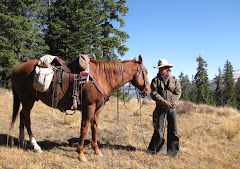
Showing posts with label horse training. Show all posts

Monday, November 9, 2009

Peace Returns

In so many ways.
A warm spell, perhaps the last until the end of March.
Calm, a rest from work, a reprise in play, the pasture is melted out, gates open wide, spirits soar and simply run free. A letting loose across the mountain like a warm, fresh breeze. The horses pretend they are wild. They do not need me until feeding time. I let them enjoy their freedom, and watch them as if they were untamed and boundless.

The experiment worked. The stallion, Flying Crow (Fadjurz Ideal) has returned to his herd, and is getting along.

Good old ground work. All it takes is time and patience, but it works wonders. At least, that’s what I’m giving the credit to here. See, my hope was that if doing ground work with a horse improved their manners around me, perhaps my doing ground work with the stallion in and around his herd might remind him that he has to behave around the other horses as well.

For three days, I led him out of his separate pasture and into his herd and spent about fifteen minutes doing work in hand – moving front end, back end, backing up, longing, and leading. A subtle and simple dance under my lead, with his herd members flocking about him perhaps in curiosity, perhaps wishing it was they receiving my attentions.

On the forth day, I brought him out to the pasture with his herd, went through the lessons, then took off the halter and let him go. After standing there near me for a few minutes, he finally put his head down and began eating, then milling around his family. But not chasing them.

It was one of those things I kept looking out the window for, waiting for. I was sure I’d see it. I was expecting him to “remember” how badly he felt the need to run after his 2-year old, Tresjur, to boss his herd around, to give them all chase, cornering the mares and yearlings on one end, and keeping Tresjur far off on the other.

I never saw it. It never came. It never happened. Five days later, I have realized that something worked. I would like to hope I can take the credit for showing him the necessity of behaving around the herd. I would like to think it was all thanks to “ground work.”

What ever it was, something worked. I’m not the only one grateful for it. You can bet young Tresjur is mighty thankful. Was it the ground work? Maybe. I’m always amazed what it can do. Regardless, we’ve got a bunch a happier horses out there, and a happier person in here watching them all get along.

Monday, November 2, 2009

Graduation Day: The first ride


This is it. The big day. All the work with the newborn foal, the weanling and the yearling is paying off. We finally get to ride!

And because of our previous work together, this day is uneventful and a positive move forward. A giant step in my mind, but a natural progression in the horse’s.

Now, remember here, just like our Graduation Day, this doesn’t mean the horse will know it all, do it all, and have their Master’s. That’s up to us, to time, to training… but now it can be training under saddle, and a lot more fun. Take your time – allow the horse to understand and enjoy. Why not? I’d rather my horse want to be out there working with me, not tolerating another lesson, another task, another unpleasant day.

So, here we have the two year old. This is Tresjur of the Rio, a half Arabian/half Quarter Horse born here on the ranch out of our mare Tres and our stud Fadjurz Ideal (Flying Crow). He’s gone through his imprinting lessons, his weanling schooling, his yearling courses… he’s ready to ride. We start by refreshing all lessons we taught to him as a yearling. I am amazed how he remembers everything. Nothing is forgotten. No time was wasted. On the contrary, what was challenging for him to understand last year, he gets perfectly this year. He only requires a light touch, a gentle request. He leads politely; moves ahead at a walk or trot with a simple request; backs; moves his front end around his stationary back end; moves his back end around his front feet; gives lightly and easily to lateral flexion; turns into the feel of the rope halter; responds to voice and a gentle side pull for “whoa.” He has been saddled before, and is comfortable with us standing over him, leaning on him. He’s ready to ride.

I call on my secret weapon: my husband, Bob. With the horse under my lead, my husband slowly and kindly mounts, allowing Tresjur time to adjust to the added weight on his back, and become comfortable with one of us petting him… from up there. With Bob just sitting, I ask Tresjur to move. Slowly at first, allowing him time to adjust now to the added weight. His first step backwards is his only adjustment. You can tell it feels different. From there on, he handles it well. I have him do all his lessons again, quickly passing through the tasks of backing, moving front end, moving back end, flexing, stepping forward at a walk, moving out at a trot. Bob does nothing but sit. We leave the corral and step out on the ranch.

Next, I give Bob the lead rope. We work at this stage still only with a rope halter and marine rope lead without additional hardware or weight. It is what the horse is used to. He understands this communication. We do not need more. So, Bob in the saddle now asks Tresjur to go through the same paces – back, front end, hind end, flexion, walk, trot, canter, whoa… rest, relax… I walk beside Tresjur and reiterate Bob’s requests with the verbal cues and hand signals he is used to. This way, Tresjur not only has the commands he’s comfortable with coming from me, but is also understanding them from the new perspective of from the rider in the saddle. The whole time, Tresjur stares at me directly in the eyes, looking for the right answer. I smile, pet him, tell him he’s doing great. I want a confident horse. There’s a lot of scary stuff out there.

Finally, I step back, and Bob continues alone with Tresjur. Tresjur now understands. He is receiving the same requests, in the same language, for things he already knows how to do, but now they are coming from the saddle, not the ground. It is easy. It makes sense to him. He does wonderful.

We keep it short and sweet. Ending on a good note. Bob knows he can ride that horse out and could head up the trail. I have to encourage him off the horse – he’d rather stay on and ride. We’ve been working two years for this day. Every time, with every colt, it can be as rewarding, as exciting, as wonderful.

This same day, we take the first ride on Canella, a four year old who is late in receiving her first ride, though has all the ground work from day one that Tresjur had. We chose to postpone her first ride for two years to allow for a injury to heal. She had been tangled in barbed wire at two weeks old and twisted her leg. We were concerned she might never heal strong enough, and have used her as a broodmare while waiting. Time seems to have healed her. She may not be a performance horse, or capable of very many miles each day, but she’ll at least be able to be part of the team, and out there on the trail in small doses, with us instead of being left behind.

Now we can take them on short rides, exposing them to the trail, refining our lessons, working on new ones – opening gates, checking fences, up and down slopes, crossing ditches, roads, creeks. There will be obstacles to overcome every day. Challenges. Life lessons. Look at it as fun stuff. We try to help the horse learn and grow with every experience.

At this stage, there are no bad habits to overcome. Any bad habits from here on are those we teach. We try not to! We take responsibility for our horses’ education, and allow them to grow into the partner we wish them to be, know they would rather be, not a problem we settle for. The choice is ours, and the difference is in the amount of time we are willing to give to the horse, and in our leadership, lightness, direction, communication, consistency, and in the patience we are able to allow him or her.

Saturday, October 24, 2009

High School Years: The Yearlings

My son is in high school. I think he’d tell you what he’s learning is a lot harder than what a yearling learns. He’s right, of course. But I’m sticking with this analogy because it shows how we’re taking the basic knowledge learned in elementary school, fine tuning it, and bringing it to a higher level. Sort of like high school was for us, though not near as difficult. Or as long. I give it three days for the yearling. Bet my son wishes high school could be so quick…

So, onto the yearlings, and their lessons.

In three days, we teach our yearlings the basis for communications and movement, teaching everything the colt will need to know to make his first ride a success. Everything except the rider.

In three days, we teach the horse to move his front end, move his back end, back up, move forward at a walk, trot and canter; and stop. We teach him to choose lightness by offering lightness first. We teach him to enjoy working with people by making it fun and interesting. We teach him to understand by being clear and consistent with our communications.

Using the same methods of teaching and training as discussed in the post entitled Elementary School, we ask our horse to move off of pressure in two ways: first, from our fingertips; second, from hand signals – teaching the horse to learn to listen to our body language, not just physical pressure.

Starting with the fingertips. For each, you’ll want to apply pressure very lightly at first, and slowly progress until you have a strong, even pressure. Hold the pressure (not so strong it need be painful) until the horse figures out the right move. Reward the right answer with INSTANT release of pressure, and then a gentle pat or rub. Each time, start soft and slowly progress. Horses are smart. It will only take a few times before you won’t need to progress. They’ll get it. Lightness works.

With this, I start by asking for a back up with gentle pressure on the nose where the halter or bosal would lie. Reward each step, each try. Then with my fingers upon the side of the colt's neck, I ask him move his front end, crossing over, pivoting around the back end. Next, with pressure behind where the back cinch would be on the horse’s flank, I ask him move his back end around, pivoting now around his front feet. Then, I ask for forward motion with light suggestion of the lead, staring with a walk. When that’s mastered, we’ll increase gate speed to a trot and then a canter. I use verbal commands, accompanied by increasing my own energy, and urging forward motion by continuing to point the lead in the direction I would like the colt to go, while increasing pressure, usually simply by waving my hands or a lead rope in the direction of the horse’s back end. Finally, I ask for a stop, quickly and suddenly, with a firm “Whoa” and a pop of the lead rope as cue, having the horse turn and face me. And then let him rest a moment. Makes “whoa” be a really good thing, something to look forward to.

Along these lines, this is good time and way to teach lateral flexion and then turning into the direction of the lead.

Moving onto the hand signals. Take a similar approach as with touch, but contact may never be necessary. Start with a mild hand signal. I use a soft hand with a pointed finger. This will signify a move in a certain direction if I point to part of his body or in a direction in front of him. I’ll start with a subtle but clear hand motion. If no response, my hands may raise and make a more dramatic show. I’ll increase pressure until at the highest form of pressure, I have to touch the horse. All along, he’s been looking for the right answer, so pushing him now will often come as a “Oh, so that’s what you were saying,” reaction from the colt.

With this, I would like the yearling to learn to back up when I stand in front of him and gently shake my hands or make a subtle pushing motion; to move his front end around his back end when I point to his neck and softly wag my hands, and his back end around his front end when I point to his hip; and to move forward when I point and wave ahead of the horse in the direction I’d like him to go.

I’ll introduce the concepts on the first day, only at a walk. The second day, it’s a reiteration, often with a little more resistance, and ask for a trot. The third day, chances are he really gets it, and we’ll progress to the canter for just a moment or two.

At the end of these three days, you can also introduce a saddle and allow the colt to feel comfortable with pressure from the girth and weight on his or her back. Let him smell it and explore it first. There’s no rush. If he’s afraid, lead him up to it. Don’t tie him down. Let him walk away if he’s that scared, and slowly bring him back, a little closer each time. In time, his curiosity will get the better of him, and he’ll have to touch it with his nose. Likewise, with raising and lowering the saddle onto his back, start with the blanket, and advance to the saddle, taking it on and off until he’s bored with each. We do not mount a yearling, and only put a few rides on a two year old. We are not in a rush to wear out our horses. We can wait until their bones develop, take our time training, and hope for an awesome horse working with us well into their twenties.

It is not uncommon that a yearling may show more resistance than a two year old, because for a yearling this is all new. Doing something that is asked of him, in itself, is the hardest lesson. Don’t fight it. Make it fun. Walk away if you lose patience. All the work I do with yearlings makes working with a two year old a breeze. They remember everything (so make it a positive experience) and are that much lighter, softer and easier for it, even after – or because of - a year off. So… next, onto the two year olds!

Thursday, October 22, 2009

Running like the wind... unintentionally.

After a summer of regular use, trail riding, simply walking on the trails, even for hundreds of miles over the summer season, even in this high elevation and challenging terrain, is not enough for some horses. However, just walking along the trails is the primary part of my horses’ job. Be it taking guests on a trail ride, packing in a drop camp to the back country, or bringing the three of us into the Wilderness for our Ditch Digging Job. Our horses spend a lot of time… walking.

But for my little Arabian stud horse, simply walking did not seem to be enough. To begin with, I could never get him to sweat. A sure sign walking just wasn’t doing it. No matter where or how far or how long we walked, it was not big deal for him. Ho-hum. What next, Ma? And although I’m a reasonably small woman, he still seemed so little. So thin, so frail!

I suppose if I rode him only, put on more miles, or if days were only longer. However, I lack the time or the opportunity… Too much else to do. Sound familiar? We never do find enough time, do we? I suppose that’s why they invented exercise machines. But I just can’t get myself to go there when I live here: high in the mountains surrounded by unlimited miles of awesome horse trails.

Whereas my Quarter Horse is all beefed up from a summer of equal use, this little fellow needs more. So, in a final attempt to buff up my little stud, we’ve taken to measuring out a special supplemental diet. And running.

Figured it would be more work out in less time. And if you’ve ever tried running yourself at 10,000 feet plus, you’ll understand why I thought this could get him in shape.

We’re a mere 20 days into the new regime. Guess it is working. He’s still pretty little and skinny, if you ask me. But he’s getting stronger every day. All this running and extra calories are paying off. So, now I’m left wondering if this was such a good idea after all.

See, last time we were out there, doing great. Obviously we can’t run the whole way. Steep mountains. You’re supposed to be smart. So, we’re out there, yes, walking, but covering some fantastic terrain, up and down slopes where he had to practically slide down on his rump and I got to pretend I was the Woman from Snowy River. And then we hit this wide open park. Wide open but filled with frightening obstacles like snow and mud and puddles and brush and rocks and sudden holes in the ground and drops offs in the seeming smooth terrain… And I ask him to run.

I suppose he really thought he should give this one his all. So he gave it to me.

Part of my job is helping riders feel secure on the trail. “If you horse ever takes off or feels in any way out of control, it’s real easy: just pull on one rein and turn the horse to the side, tight and quick.” I say that all the time, all summer long, and have for plenty of years. It’s always worked. For me, and for them.

Well, tell you what, it didn’t work on this day. Try as I might to pull that horse’s head to the side to come to a stop, not to mention just a bit of control, it didn’t work. He didn’t feel it. Perhaps he forgot I was there. On a technical level here, folks, I was riding in a “loping hackamore.” No bit. Nothing more than a soft nose piece and cotton reins. Just a little more than the halter I trained this boy with. A tool that fools a horse into believing you actually have control, when what you really have is a well mannered horse. I always figured that was enough. On this particular day, at this particular instance it was not. I swear he didn’t feel it at all.

For what seemed like a looooong time, but was probably just a matter of minutes, that skinny little boy ran around that mountainside with me firm on his back, eyes tearing from the wind, one arm pulling desperately on the rein and the other above my head, trying to prevent my hat from flying back, mighty glad for a good seat and outstanding footing from this little barefooted fellow. I was thinking how crazy we must have looked if some tourist was up on the mountain looking down at us running full speed ahead in some random track about this hillside.

Funny, when we’re at a walk, he often stumbles. At a full out gallop, he was smooth as silk. Lightening reflexes. I remember seeing puddles and snow piles and gofer holes and ravines all flying into vision and thinking, “oh boy, this is it…” but he’d manage to swerve around or over or through, just in the nick of time. Impressive.

When I finally did resume control and managed to get his head around and his feet stopped, he was calm and relaxed. Instantly over it. Over whatever got into him where when I asked him to run, he did, thank you, but… he forgot what the word “stop” meant. He wanted to run. There was no fear motivating him, nothing spooked him, nothing wrong. I think he did it because it felt good. Isn’t that what I wanted? Isn’t that what I asked for? He’s an Arab. He wanted to fly!

I never had a horse take off on me like this, and I can’t say I’m very comfortable with it. I was, for a matter of minutes, out of control. And yes, as a horse rider and trainer, we say it’s all about control.

I’d say I’m too old for this. But truth is, it was exhilarating. But foolish, I know. My rule of thumb: never ride a horse over whom you have no control. Well, I’ve got some, but I saw my weakness. We were lacking in a few control issues. Communication issues, perhaps. We’re back in school to polish up these aspects. Ground work. In cases like this, we hope ground work really is the basis for a solid foundation.

The snow and deepening mud postponed our running for the past few days. I think the trails may be dry enough soon. I will find no further excuse.

And yes, he’s named Flying Crow for a good reason. Careful what you name your horse.

Monday, October 19, 2009

Elementary School - Working with the Weanlings

Onto the weanlings.

Throughout the first few months of the foal’s life, there’s a lot for the youngster to learn, and a lot of opportunities for us to teach. This is an easy time to build a solid foundation for a lifetime of learning and working well with people.

For the weanling, this is a time of newness and adventure, of being confident enough to start to walk away from mom, play with other colts, and interact with humans and the world around them on their own, not just following in mothers footsteps. They are bold and brazen on one hand, and quick to run back to mom on the other.

The earliest we have separated colts from their dams is at four months of age. I prefer later, about 6-8 months old. It’s easier on everyone then. Moms will wean their babies on their own at 8-9 months of age. Ideally, I let them do it, and they do a good job. They’re ready to get that baby off them, and are preparing for the next. It’s a natural and easy progression, but it’s not always “convenient” and doesn’t fit into our human schedules, so we have to adjust for our own needs from time to time.

So, “weanling” is a relative term. In my book, it’s when they’re older than a foal, and younger than a yearling – any time between 4-9 months of age when they normally or naturally would be weaned. This should be a time filled with good experiences to encourage trust of humans, safety in handling, understanding of their place in the herd, and confidence and curiosity in the world around them.

In addition to specific “school” lessons, opportunities for the weanling to learn and grow present themselves regularly. Lead or ride your mare, around the barn yard, around the ranch, around the mountain… where ever you are there are opportunities… and allow the weanling to follow, to become exposed to everything – motor bikes, trucks, road, ATVs, dogs, cats, chickens, bridges, water crossings, tarps, sights, sounds, smells… Just following the mares around our guest ranch exposes our colts on a daily basis to more than I could possibly and creatively dream up. In addition, ideally I’ll take the mares out on the trail and expose the weanling to even more. When following a calm and polite mother, the youngster will follow with ease and confidence up trails, across water crossings, through the woods, across roads.

All this, and then we take time for proper schooling.

Onto Elementary School
I don’t have a set schedule – it is dependant on when we find or make the time – but some time when the youngster is between 4-9 months old, I try to take three days in a row to work with the colts. Consistency is key to working with the colts, so I make sure I can take time for three times, three days in a row, and do the same lesson, the same way, each time. Ideally, each time we progress.

We treat the weanlings and yearlings as we would any green horse, and introduce lessons in the same manner. Each lesson is taught in stages. Start soft. Every time. That’s how you teach softness. Often, I will progress to firm. Remember how a boss mare will move the horses, first by looking, then pinning her ears, and after that, she might just lunge forward and bite the other horse to make him move. Well, I’m not big on biting, but I will be firm enough to get the results I want. And just continuing to ask over and over again “nicely,” well, I call that nagging. So does your horse.

So I say to myself as I’m working a young horse, “Ask nicely, then ask firmly, then TELL!” If I ask, I mean it. I don’t want to ask a second time, though in the early stages of teaching anything, I will have to. I’ll progress from my ASK to my TELL more slowly in the beginning. After the horse gets it, my progression speeds up. Ideal, I expect instant results. That’s what we need on the trail for us, and with any discipline for you. Ask and then wait around a while for the results: that spells danger. And certainly, I don’t want to nag. It’s that “fair but firm” thing. It works. Horses get it.

In everything I do with the young ones, I keep the boss mare as my role model on one hand, but remember I’m a human on the other. We can learn from the horse, but we’ll never be a horse, and we won’t fool them we are. But we can work with what we have, which is (or should be) understanding of the horse, and leadership that comes with being a human. This is what we strive for. A balance, summed up in these two words: positive leadership.

What we’re teaching here is good habits, good manners, good ground control, good handling. From the human’s perspective, of course, but it is this which builds the solid foundation for all our future work together. It boils down to establishing leadership (yes, it is a matter of control, but I have no interest in riding a horse over whom I have no control!), and teaching a few basic skills.

One book for specific ideas on working with weanlings I’d recommend is John Lyon’s “Bringing up Baby.” There are some fun and useful exercises in there, and he teaches the lessons to the human very well. My favorite is his first one – teaching the colt to move, then turn and face you. Rather handy…

As a quick reminder, for each of the “skills” you teach, be sure to do it on both sides. What one side learns, the other may not. Teach both sides the same lesson for a balanced horse.

The Skills Lessons we teach our weanlings is like grade school for us human. Combined with the chance to run around, room to grown, opportunities to learn to move, where to place their feet, and social skills in their horse herd, these are the basics of their future training no matter what discipline. These lessons are taught to the weanling, repeated for the yearling, and reviewed for the 2-year old who then moves on with further training (we’ll go into that in a separate post).

With each lesson, go slow. If your colt is uneasy at first, approach and retreat. This gives the horse confidence and trust in you. That’s big. Horses don’t have the agendas we have. Don’t be so focused on your human goals that you fail to see the slightest changes within the horse. Reward those changes. And the best reward is: releasing or relief. Sometimes that even means leaving the horse alone for a few minutes!


The Skills Lessons:

1. Touch – The weanling should allow and feel comfortable with human touch all over, head to toe. We start slow if need be, though for most imprint-worked and flooded foals, this part is usually fun and easy. It feels good!
2. Grooming – allow for a brush and curry comb all over, head to toe, and stand still for it because if you go away, I’ll stop, and this feels too good to stop! I don’t want to tie a horse for grooming, but expect them to stand and wait while I brush them because it feels so good. Again, go slow, approach and retreat, let them figure this one out on their own and in due time. I get a kick out of this because you can tell the difference between the horses I have raised, and those I have bought as adults. Mine come running up in pasture and vie for my attention and their turn when I head out there with a brush.
3. Halter – it’s not a scary thing, but it may seem so at first. Use the halter like a brush and rub them all over, then around their head, and then slipping on and off until it can be left on and tied or buckled. Allow it to feel good. Work on taking it on and off regularly so the colt knows that, too, is a simple process, and they are not stuck with the darn thing on forever. (We NEVER leave halters on colts after we done working with them. An unattended colt with a halter is an accident waiting to happen. Please don’t let it happen.)
4. Leading – slowly teaching to give to pressure to one side and then the other. Forward motion takes a while. Start with the gentle side pull, and be happy with one step at a time. A gentle pull, then slowly add tension the side. The colt may pull back at first. Rather than fight it, go with it, trying to maintain constant pressure until the horse figures out to go into the pressure, and step towards the pull of the lead. If (when) the colt pulls back, allow yourself to go with him without putting so much pressure that the colt flips over. Start with just a gentle pull on the halter. He’ll figure it out, and put his head to that side, maybe take a step. Give him an instant release to tell him that’s the right answer. There’s no rush. You’ll be leading the horse for a life time. Teach them softness now. This same softness and feel will be the foundation for communication with bridle and reins.
5. Tying – this one comes later, after leading is mastered. The horse that understands and respects the feel of the rope and halter and goes into it rather than pulls away will be ready to learn to tie. Start by holding the rope around a post, then by loosely coiling it and leaving the horse there (near mama or a friend) for fifteen minutes, then a half hour, then eventually an hour. Increase time and tie strength slowly and safely. Whatever you do, don’t injure a colt by tying him hard and fast before he understands what that means. Some folks use inner tubes and all kinds of fancy tricks. Try by just teaching leading first. Take your time, take the time it takes, and the horse learns to respect the pressure on the lead and halter. Learning to give to pressure should be enough to teach this lesson safely.
6. Feet work – each time we work with the colt, we brush down to their feet and get the horse comfortable to touch, then comfortable with lifting, then holding, then tapping, then rasping. Watch your timing here and try to release before the horse pulls his foot away. Slowly increase your timing but without getting into a wrestling match. Remember, our goal is to have it all be a positive experience. Having their feet held should not be an unpleasant or traumatic experience. Your farrier or trimmer will thank you for teaching this lesson.
7. Gentle longing – the colt should not be run. Keep it mellow and do this at a walk. But after they have learned the lesson of leading, you can teach them to lead around you. Start by getting your youngster leading. Then walk with him, keep him moving without pressure whenever possible. Strive for a loose lead! I often lift the rope in the direction I’m asking the colt to go. If he does step forward, , I may put slight pressure on the rope. If he still does not, I make a clicking sound. Finally, I’ll swing the end of the rope behind him to “encourage” him. For most colts, this will be enough for them to get the picture, but a few may still stand and wait until the end of that rope gets closer and closer and finally touches their behind. Reward the simplest try! Instantly release all pressure when you have the forward motion you are looking for. Even just one step at first. Then repeat each step, each time. Don’t assume the horse won’t get it and go straight for swinging your rope. Give him time, he’ll get it! Be clear, and he’ll really understand.
8. Trailer loading – after you’ve been working on the gentle longing for a while, the colt gets your signals that when you point the rope, he is to follow. Some colts will follow that lead right into the trailer first time. Some, most, may take a while. Go through your stages just like in #7. Each time, start soft and increase pressure. Do this in circles outside the trailer first. Then maybe have fun with it and do it through a barn stall, a gate, get creative, build the colts self confidence and trust in you, and understanding of what you’re asking of him. Then move toward the trailer. If he doesn’t step up with the uncomfortable pressure behind him, quickly start over from stage one. No need to constantly increase pressure nor to give him a break (unless you need one). Just try again and again. Or step away and remind them what you’re asking in an environment that might not be as scary. They’ll get it. You may loose patience before they do, but stick with this slowly and sanely. I’ll take all the time I need to here, and sometimes it may be an hour or longer before the colt steps in comfortably. Then I’ll ask him to step in and out several times. Each time is rewarded by letting him rest, petting him, telling him how proud you are of him (if you’re one of us who constantly talk to our horses). This too sets up a lifetime of good habits. It’s worth taking an afternoon off to teach this one calmly, patiently, pleasantly.
9. Desensitizing or “Sacking Out” – with every lesson, do some work on introducing objects or feels or sounds or sights to your horse to get him more familiar with the unfamiliar, and learning how to comfortably handle the unexpected. I like to make it a game. Bring in ropes, blankets, plastic bags, tarps, saddles, slickers, clippers – funny things! Make them fun, let them feel good, take your time, and wait for your colt to be comfortable, even bored with each new object. Go slow, approach and retreat, allow him to put his nose on it. I don’t know why they always have to do that, but you know, they do.

With each lesson, strive for an experience for your colt that results in his feeling of enjoying people, looking forward to learning, and increasing his knowledge and confidence. Each lesson should end on a positive note. Forget about schedules and goals – these ones will last a life time. Take the time it takes. Make it a positive experience for the colt.

My goal in working with the young ones is to help grow a confident horse that respects my leadership, understands my requests, and enjoys my company. I want to do my best to ensure safe handling, no matter what arises, and establish a solid foundation for future ground work and work in saddle. We strive to have our lessons with the colts be a positive experience for them, teaching them good manners, preparing for a good future together, and enjoying time together right now.

Wednesday, September 2, 2009

A DVD Review of "The Linda Tellington-Jones Series: Riding With Awareness"

Not being one to leave the mountain very often, I have learned a great deal at home from books and DVDs. They have been my horse mentors. All of different names, styles, philosophies, teachings… and from each, I have taken what works for me and my horses, at whatever level I find myself learning at… or stuck at.

After a summer of theory in practice, but little time to sit and watch a DVD, my boys are off to town (getting me, or rather my horses, more winter hay) and I found myself with time… I chose to watch “The Linda Tellington-Jones Series: Riding With Awareness” DVD. This comes with special thanks to Kim from Enlightened Horsemanship Through Touch. Thanks to her Blogging Contest earlier this year, I was able to receive and view this DVD.

Let me start by saying that although I have heard of Tellington-Jones, and the T-Touch for many years, I have not read her books nor seen her speak first hand. From there, I can tell you, I learned it is time I did…

The majority of the material covered in this DVD is not basic, introductory information about the TTEAM approach, philosophy and method. It is assumed (and suggested) that the viewer has essential knowledge of Tellington teachings. I did not, however was still able to get a good deal out of this DVD. In fact, I was so inspired by the bits and pieces I could put together from her very clear and simple teachings, combined with my previous horsemanship knowledge, that after viewing mid-way, I couldn’t resist running out, saddling up my little Arab stallion and trying some new stuff with him. To great result. Then after watching the second half, I can’t wait to saddle up again tomorrow to test out more new methods.

Her teaching made sense to me. The fundamental premise she began with was the statement that everything you do should be as comfortable as possible for you and your horse. If it’s uncomfortable for either one, we (more than likely: me) are doing something wrong. I fully agree, however I do not always figure out the right way on my own.

Her section on practicing hand movements with the reins on an innocent victim (her sister) were so clear that although I could not find a willing victim, I could see the point Linda was making, and you just sort of “feel” the right way as she’s talking and showing you, if you pay attention. Likewise, her simple demonstration of the posting trot, again using her sister here standing up from a chair, was one of those “Duh, why didn’t I think of that before?” moments.

I do not (to refer back to a comment from Jane of the Literary Horse) drink anyone’s Kool Aid, but try to take what works for me, my horses, and my somewhat unusual circumstances of high mountain outfitting with a positive approach to horsemanship. And although I do believe everyone out there has something to teach you if you’re open to listen and learn, there are some people you can see have obvious and great knowledge, skill and insight when it comes to riding, horses and horse handling. I could see Tellington-Jones was one such person, and that I would be smart to take the time to listen to her. I may not want to follow her or any teacher’s direction 100%, but a good teacher I would imagine leaves room for the student to take what works for them and their horses, and put new theory into practice.

For example, although I believe all horses should accept and understand a variety of bits, I prefer riding and refining my little stud with a hackamore, a traditional rawhide bosal and horsehair mecate. Many of the same principles Linda teaches for her roller leverage bit worked wonderfully well with the hackamore.

Well, a detailed review for those already knowledgeable of Tellington’s TTEAM solutions this is not. But for those of us “green” to her teachings yet with a basic knowledge of horsemanship skills, it’s a good step forward in learning, and a good start to understanding the T-Touch and TTEAM systems. I can say it has inspired me to see and learn more from Linda Tellington-Jones… Any more contests coming up, Kim?

Sunday, July 19, 2009

Lessons learned from a little stud horse

We’re finally working together, my little stud horse and I. I mean really working. Guiding rides, and riding up the mountain to our camp in the Wilderness where we work mid-week, picketing, high line, the whole nine yards for the life of a working mountain horse. As well as giving us some lovely colts…

It took us three years to get here. I often think it should have taken us three months. I suppose if I knew then what I know now, it would have been so much easier. For both of us. But it was all these lessons we learned together that got us to this point, and gave me the knowledge to do so much better… next time. In the meanwhile, he forgave me for all my mistakes, and helped me learn the right way; showed me what I needed, and is still teaching me plenty most every day.

The biggest lesson he taught me I think I only now finally get. That I need to be a good leader first, and a good friend second. Just loving him and caring for him and being nice won’t get us up the trail safely. I wished it would. I tried that for years. But he needed a leader. And once I learned to be strong and firm but fair, to be a good leader, then and only then did he really want to be my friend. Before that, I see now, our friendship was on his terms, and at my expense.

I could ask ten times. That is no longer asking. That is nagging. Horses know how to tune that out like a child of an irritating mother. I didn’t raise my child that way. Why couldn’t I treat my horse with the same respect I treat my son? I ask him once. If he doesn’t get it, I figure either he didn’t hear me, or I perhaps I didn’t communicate clearly. I may try again, a little more firmly. If I have to ask a third time, he knows I’ll demand a response, and rightfully so. It should only take once, if done right. I know how to talk to my son. It came easily to me. I treated him with the leadership I wished I received as a child. Not just friendship. But true leadership. Direction. Help. Protection. Because I care about him. I love him, and he knows it all the time. I may not play with him or be a soft and warm and fuzzy mother. He says I’m like the mama wolf, and he knows he’s safe, and he knows if I ask once, I mean it. I may not ask a second time.

Finally, I am learning to treat my horses with the same care and respect. If I care about them, I will be their leader. With love, and kindness, and strong protection. I will ask only once nicely.

Finally, I am learning to be the leader he has been looking for. Now and only now, can we truly be friends.

Friday, June 26, 2009

A job to do

It helps to have a job to do. A job gives us focus, direction, motivation, clear goals. It’s the same for our horses, isn’t it? Likewise, without a job, I might not ride… might not find the time. And my horses might just hang around grazing all day long.

Though coming up with a job isn’t that hard to do. Especially when it comes to horses. A job does not always have to be as intense as packing us and our gear into Ditch Camp, or pulling a slip to clear dirt. A job can be more simple to find and do. Our job can be training, which really, we can look at as an opportunity presenting itself to us every time we ride. Or clearing trail. Now that’s a great way to “write off” a trail ride as a productive afternoon well spent!

Trail clearing may not be a regular part of your riding routine, but it tends to be an important part of our spring and fall schedule, when the trails we use for day rides are accessible only as far as we maintain them. When we can, we pack the chain saw in the saddle scabbard (see above). When we can’t, as in, when we are working in the Wilderness, we carry a good saddle saw and hatchet at the least, and a two-man cross-cut saw at the most.

The stop and go for the horses, getting on and off, often at odd and uncomfortable locations, the patience of waiting while we work, of listening to the sawing and branches snapping, and allowing mounting from the “off side” – these all provide valuable opportunities for training our horses, and for us, working on our own riding skills. Each time out, we strive to improve our communication skills with our horse, which will be evident in how well they respond to the work at hand and the variety of tasks we request of them.

The goal is better set as the process, the learning, the doing; not so much as the actual amount of dirt moved or distance covered. Perhaps this is impractical in our day to day jobs, however if we look at the task at hand in terms of how we accomplish it. This is a better focus than the narrow eyed veiw of the end result. This is how through our jobs, training, for both horse and rider, is truly achieved. The goal then is keeping it positive. Or at the very least, on those difficult days when we just don’t get it all right, finding a positive note on which to end the job.

I suppose the one exception I’m able to make with myself is those times riding or being with the horse is for therapeutic value. My own therapy. No work, just being, feeling, relaxing, unwinding, breathing… I’m not talking about anything professional here, just how good I feel riding, out there with my horses. Although it is rare, I can still occasionally justify taking the time for nothing more than a simple ride, an early morning silent ride just me and my horses, at the end of the season when the trails are clear and the ranch quiet, to clear by mind and settle my soul.

I leave you today with a quote, perhaps just a quip, I saw in a fancy horsey item catalogue that’s stayed on my mind for weeks now:

Feeling down? Saddle up!

Monday, June 8, 2009

Introduction

In my last post, I introduced to you Beka, who we're lucky enough to have here at our ranch for the summer. As I mentioned, I am learning a great deal as I take the time to teach, to introduce Beka to our herd and horse handling, riding, etc. (My victim!) Beka too has a blog and is writing about the experiences from her point of view. It might be interesting to see what she has to say, what she learns, what works from my teachings and her expereinces, etc. For me, it's another great opportunity to learn...

Beka's site is: Imperfectly Living a Perfect Life

Saturday, June 6, 2009

Horsemanship 101

A wonderful opportunity presents itself to us each time we are given the opportunity to introduce the horse, perhaps for the first time or in the early stages, to one we can see has that passion or interest. Suddenly, we become beginners all over again, and in seeing things anew, perceive things more clearly, more defined than perhaps we have in a while. The process of instruction brings learning to both student and teacher.

For years, I was lucky enough to have such opportunities with children at camp, eager and open to do it all, as long as horses were part of the package. Over the years, here too I have such opportunities; not with children but with the open mind of a new beginner adult, on a weekly basis throughout the summer.

Each of these opportunities were limited in time and therefore in scope. At best, at camp, you can only teach/learn so much in a week or two. And likewise, here at our guest ranch, I can almost assure a beginner a safe, comfortable and enjoyable ride. I take great pride in this and truly enjoy sharing the time well spent with horse and rider on these awesome mountain trails. However in just a couple hours, and without a “follow up visit”, we end it there, and hope for the best next year, or in a few years when that person returns and wants to ride again.

This year, I have an exciting opportunity present itself to me in the form of an enthusiastic and athletic young woman here to spend the summer with us. She’s not a horse person… yet. We’ve got the whole summer to work on it, and with her energy and interest, I think it’s going to be fun for us both. I tease her that she’ll also learn to be one heck of a cabin cleaner, which isn’t exactly the brightest side of the position, but it is part of the package deal. (And really not that bad, I promise her.)

And so, I find myself given the opportunity to see horses and learn their handling all over again as I present it all to my summer helper, Beka, who comes with limited horse experience but great ability and interest. I tend to find the latter two so much more essential than the former. The bottom line is you have a clean slate waiting to be filled with poetry. In this case, poetry in motion. Horsemanship.

The first thing we went over is something you can spend a lifetime perfecting, yet it is so remarkably simple you may laugh that I give it such importance. Getting the horse in from pasture.

To begin with, it’s all about body language. I explain how I don’t try to sneak up on my horses. I don’t try to be the predator and chase them in to the corral where it’s easier to “catch” them. (I did have to re-teach the old dogs this new trick, as this is the way it was done here for years.) I approach the horse directly, with respect, but not like the human/hunter that they fear us to be. Firm but fair, remember? You can see their reaction to you from a quarter mile away. If they are scared from way back there, you better slow down, approach and retreat, and turn down the human/hunter in you.

When you come near the horse, I’d like him or her to turn towards me, and better yet, take a few steps towards me. You can “reward” them with treats. I don’t believe there is anything wrong with that, though I prefer to give a kind word and a gentle rub.

Then and only then do I halter the horse, followed by another kind word and gentle rub. And then we proceed to practice leading.

Here again that body language thing comes in to play (doesn’t it always?). I want my horses’ shoulder in line with mine. He or she should not be any further in front of me, so that if I stop abruptly, so will my horse, and be no further ahead of me. Should he or she push the boundaries and step ahead of me, I take control of his or her feet, and then ask my horse to walk completely around me until we’re lined back up, shoulder to shoulder.

There is no pressure on the lead rope unless I need to up the pressure. Otherwise, I’d like to have my horse expect the light touch.

While walking up through the pasture, I’ll make a few sudden stops just to keep my horse alert and paying attention to me. Perhaps even stop, then take a few steps back. I’ll expect my horse to step back in line with me. If just my walking back is not enough to signal to my horse to walk backwards with me, I’ll flap my elbows and act bigger. That usually does it. But if that’s not enough, I’ll raise my whole arms and swing the lead rope and make sure my horse understands I’m backing up and I expect him to as well.

As always, start soft. Assume your horse will not need more than a light touch or gentle signal. But up the pressure if need be, never to the point of pain, but only to the point of getting the results you want.

Be careful here though. More often than not a horse doesn’t do what we are asking because we are not being clear in our request. Perhaps we need to stop and take a look at our own body language and movements and see what we can do to improve our communications with the horse before we quickly blame him or her for “not getting it.”

Leading a horse in from pasture is something we do almost daily. Seems to me it’s an opportunity each time to advance with your communication skills, fine tune the effectiveness of your body language, and constantly improve your relationship with your horse.

Opportunities present themselves in the simplest ways at times. I hope I don’t overlook too many in my rush to just get it done or get there.

Saturday, May 30, 2009

How to slicker-proof a horse

In consideration of saddling in the rain, the question was raised on how to get a horse slicker-proof.

I don’t. I hate to say that, but it’s true. You can get any horse used to it, comfortable with it, and understanding of what it is so that most of the time he or she will be just fine with it. But I’ll never underestimate the wonderful mind of horse. Being the thoughtful, thinking, yes, even sometimes moody creatures that they are, I can’t guarantee that every day they will be OK with it. Would you be if someone suddenly threw a crinkly big blanket over your back without warning?

Therefore, I never take the act of untying my slicker from the back of my saddle, shaking it open, and slipping it on for granted. Or at least, I try not to, in order to be most respectful of the horse. Instead, I take just a second to let him or her know what I’m doing. “Hey you,” I tell him or her, by sliding the rolled up slicker from behind him and allowing the horse just a second to see it, “I’m putting this on. Remember this?” If I do that, he’s fine. If I don’t have the respect for my horse, or have him so desensitized to stimulations that he’s oblivious, I don’t want to be out there with that horse.

I will “sack out” the horse to the slicker before hand, and a tarp, and a plastic bag, and many other things. This is an essential part of ground work. Approach and retreat with the scary object until the horse is comfortable with it, and has therefore decided “on his own” that he can handle it, that it’s really not so scary. With each object, we build our horses’ confidence.

I do not want to completely desensitize my horse to all objects and motions and movements and sounds. They are horses – their sensitivity is an essential part of their nature, and I don’t want to change the horses’ nature. What I can do is increase their confidence by giving him or her the opportunity to deal with and overcome many challenges; and I can give him or her the necessary tools to handle his or her sensitivity. For example, even the most bomb-proof horse, unless he or she has been so deadened by overstimulation and is in an unnatural state of mental shut down, will spook from time to time. But a spook could and should just be a quick turn towards the object to check it out further, or a quick step to the side. Who among us with a good mind does not get startled from time to time? A horse could and should learn that a scary object, or a spook, is best handled with a simple motion; not a rear, a strike, a bolt, a buck or running back to the barn.

So, I allow my horses the opportunity to become comfortable with the slicker from the ground. Very comfortable. Then I try it from the saddle at a stand still. Slowly. Give him time to get it. Then hang the slicker from a railing or tree and ride the horse over to it; have him approach it, accept it in his own terms, and slowly pull it off and allow your horse to carry it. If it’s easier to start these things from the ground with the horse in hand, take your time, and do it that way. Just give the horse time to accept it, learn it, and realize on his own terms that he’s OK with it. Allow him the time to come to his own comfort level with. Don’t rush it, push it, or force him. Encourage him. Reward him. Pat him and tell him he’s done good.

I don’t think it has ever been a problem unless I (or others) have simply not had the respect for our horse to “tell” him or her what we’re doing, and think it’s OK to just whip open the slicker and shake it all over his back all of a sudden. I don’t know about you, but if I was that horse, and someone threw a fast ball like that at me unexpectedly, I’d be a little ticked off too.

Tuesday, May 19, 2009

Part IV in the series on Horse Packing How-To: Getting the string together


Getting the string together starts with teaching the horse to both lead a pack string, and be part of the pack string. I never gave this much consideration until last week. Usually it’s just been a quick session of showing the horse what I’d like, what works, and allowing him/her the time and opportunity to get it. Really, it’s that simple.

Using a well seasoned, experienced horse, I’d ride one, and pony the other, then switch off. All of this work has already been introduced on the ground, and at this point, is well comprehended by the horse. The horse is comfortable and knowledgeable with what you are asking. The added ingredient here is only that you are asking the same things from the back of a horse, not from the ground, but that’s a remarkably simple transition for the horse. It only becomes more difficult for the person because of the complications of juggling the two horses at once; and any subtleties of fear and confusion on the part of the rider emerging into the equation.

Ideally, every one of our horses should be able to do it all: lead/pony, be led, and pack, step out as a guide horse, and follow in line as a dude horse. We can train each to do all, but some horses will excell in some things, others in other things. You can train any horse to learn and do anything, but you can’t change who he is. You can’t change his personality, and why would you want to? The best we can do it work with who they are; help them be the best at what they are by developing their strengths and helping the horse overcome his weaknesses; and do our best to help them feel safe and confident and understanding of the work at hand. All with positive leadership, without fighting or working against the horse. Our goal together should be to get whatever job needs to be done, done well and smoothly and comfortably for us, our horses, and any accompanying riders.

I know for many folks, having a “job” to do is not necessarily where you’re at. Most folks are not out here with an actual job. But I think it is all a matter of how you look at the task at hand, how you choose to focus and present the goal to your horse. Your “job” can still be a goal of getting safely and timely to a destination, working on a new skill, or a focused discipline in an arena. If you look at the task at hand with focus, it is still your, and your horses’, job. Somehow, I think it helps both horse and rider to have that focus.

OK, now all this said, last week I ran into the first major complication of this equation: the stallion in the pack string. There may be many a more confident and experienced horseman out there for whom working with a stud is simple business, but it throws me for a bit of a loop from time to time. Each simple task can become an escalated issue. But like everything else in learning to work with my little stud horse, every challenge he presents has become an opportunity for me to fine tune my learning, understanding, patience, leadership, and ultimately, my knowledge and skills as a horseman.

Like with so many specific “problems” we may have with our horse, if we overlook the small details and focus on the big picture, often the small details work themselves out. So, with the stud being quite upset and aggressive with the mare in front of him, being led by the mare (walking around with his nose under his tail, I suppose is a big confusing to the poor boy), we worked this problem out by focusing on leadership. My stud can not breed when his is being ridden by or working with me. Get him out there working with me more, and he’ll remember that there’s a time and a place for everything, and if I’m the leader, and hopefully a fair and good one, he’ll remember his respectful place in our working relationship. If I ask him fairly but firmly to be in line, he can accept it.

For a few days, I rode the little stud on the trail, alternating places in front of (he liked that) and behind (he didn’t like that) the red mare. Eventually he became more comfortable with that place.

Now, although his ears remained pinned back when he’s in the following position, he no longer snakes behind her as if he’s driving or pushing her along, and no longer aggressive, lunging towards her trying to bite her. In due time, I am certain he’ll feel more comfortable in this place. It’s my job to provide him with plenty of good, positive experiences there so that he can become more comfortable more quickly. If I’m afraid of the matter and avoid addressing it, it will not resolve itself. He will never be allowed the chance to get over this if I don’t give him the opportunity.

Or ask my husband to help out. Bob is a far more confident rider than I may ever be. The issues I have with fear do not exist for him. So he is, at times, my secret weapon for helping me overcome a horse obstacle that has me blocked. I see nothing wrong with that trick!

Well, at the end of the week of working on this, we find that this lesson of teaching a horse to follow the lead turned into a good example of rising above the little details, and addressing the bigger picture. This little horse needed a little more time on the trail, a little more time behind the mare, before he could feel comfortable back there. Pretty simple way to work out a “problem.” But please remember this: it has never been so difficult (although it’s hard to call this one really difficult) for Bob or I to teach a horse to follow a lead. Working with this little stud from the mare turned into a good lesson for us, going far beyond this simple matter at hand here of teaching the horse to follow in line. However, these are the great chance opportunities, when the bigger picture emerges and presents us with an occasion to be worked on and improved. And ultimately at the end of the lesson, both horse and horseman have a better understanding and knowledgebase because of the time spent working on one specific skill.

Saturday, May 16, 2009

The chrome don't get you home

The chrome don’t get you home

My son is what you might call a Motor Head. Although his job is and has always been working with horses, his love, so unlike mine, is motors. Riding anything with a motor, working on motors, playing with motors, getting better with motors. You know. So, this expression I borrow from him.

Ah, but how it relates to horsemen!

Maybe you’ve seen it: the person who arrives at a clinic or lesson or group ride with the fanciest of tack, all decked out in the finest of gear.

Maybe you’ve even been there… done that….

For better or for worse, I haven’t. I haven’t had the money to spend on fancy tack. Perhaps one day I will. I’m not saying I’m proud of my bridles repaired with copper rivets and leather laces. But in the meanwhile, they work. And I’ve learned that it doesn’t matter what my headstall looks like, who made my saddle, or what kind of bit I’m using. If I’m a good rider, and good at communicating with my horses, those things are nothing but fluff, nothing but “chrome.”

Good gear does not make a good rider. The horse and rider may look great standing around there in that fine gear. Oh! And they do! But once both get moving, the fancy gear doesn’t make that horse or rider perform any better.

I’ve mentioned before my intrigue in the revival of interest in the Bridle Horse. In theory, the tack meant something to the Vaquero or Californio rider. The tack represented an improvement, a refinement, and a polishing of the horse and rider. The finer tack was a clear representation (to others) of how far advanced horse and rider had evolved, based on the elegance and fine tuning of the work together, based on time working together and an amassing of skills.

My goal for refinement with my horses and in my own horsemanship is to be the best rider and trainer and horseman I can be… without gimmicks, without fancy gear, without spending a fortune on things that in the long run are not improving my horsemanship. If I can achieve the refined results I seek without all this fancy gear, this chrome, then I will feel I’ve really succeeded. But by putting on the fancy gear, and still not being the rider or horseman I want to be… I’m being as false as a coat of shiny paint on an old beater pick up.

Along those lines, I told you before how I was working to introduce my little stud horse, Flying Crow, to the traditional Hackamore. The next stage in my journey to Chromedom. Yesterday, he and I took our first ride out there in the Hackamore and we felt wonderful, smooth, controlled, understanding. But the day before, we were working together just on ground work with my sweet red mare, Tres (yes, still working on that “learning to lead, learning to follow” lesson). Crow was decked out in all the finest: a hand tied rope halter, and home spliced lead rope. Not too fancy. No chrome there.

When my husband offered to go for a quick trail ride with me, I didn’t want to waste time changing gear, so just rode off up the mountain with Crow in that halter. We worked together beautifully. I was pleased with the lightness and ease of communication between the horse and I. I can’t say I “felt” any difference with the old rope halter as I did with the lovely hackamore. I imagine my horse did not either. If anything, I know the halter “felt” only lighter, more comfortable to him.

I guess what I’m trying to figure out here is although my goal is a great refinement, I would like to achieve this fine-tuning with my skills and abilities, not with my tack. I would like to be able to communicate with my horse just as smoothly, effortlessly and elegantly in an old rope halter, or even bridleless, as I could in a spade bit. And as such, I would personally feel as if I was a better horseman, relying more on my personal strengths and weaknesses, not on any fancy bit.

Wednesday, May 13, 2009

Fooling myself

All the affirmations in the world won’t save you from feeling like a fool sometimes. I’m there more often than not.

First, I’m convinced that both I worry too much, and I take myself too seriously. But what can I do about that? I try affirmations, but I just don’t believe them. I have not come close to figuring this out yet. I will keep trying.

I entered a blogging contest. Bad idea for the insecure. I should have known better, but I love writing, and am enjoying the blogging community, so I looked upon this as a fun opportunity to participate with fellow bloggers and fellow horsemen. I spent a week working on the post, then a week after that in anticipation of being a part of the community. When the deadline came and went for the big announcement, I figured I’d again been the fool. Nothing new there…

So of course, I’ve spent the last few days adding this to my reasons for wallowing in self pity and self doubt. Come on, girl. Get over it!

Just when I’m ready to lift myself up again from my self made misery, I receive an e-mail telling me the post actually won first place. If you have a moment, please take a look at it on the Enlightened Horsemanship Through Touch blog and tell me what you think. Only nice things, please.

More on feeling like the fool…

So, this afternoon, I’m out there trying to get you some first hand data together for showing you the next entry in the series on Horse Packing How-To. The next in the series was going to be about teaching your horse to both lead the pack string, and be led as a part of the pack string. I thought it would be a swell idea to explain the teaching process while I’m out there teaching… So, I get my little stallion decked out in a regular riding saddle, rope halter and lead, and saddle up my best mare to work off of. Well, we were looking good for about five minutes. If even. Then the stallion started the sweep: ears pinned back, aggressively following the mare. Ran in front of us a few times, in what looked like an attempt to cut us off. Even ran towards us trying to bite the mare a couple times. The mare of course kicks back and dodges his aggressions, but generally puts up with me as I’m on her back trying to communicate obviously not very effectively with the crazed stallion.

Hmmm… time to re-group. This pussy cat of a stallion, who is light like butter on the halter and lead when I’m on the ground. What’s going on inside that odd little stud head of his when I’m up there on his favorite mare?

We worked it out… only somewhat. I’ll try again tomorrow and perhaps find some insight into his behavior that will help us all figure this one out a little better, and work through it.

And maybe even, in the process, I’ll be able to learn what I’m trying to teach.

Friday, May 8, 2009

More on training your horse to stay at camp when you are still back home

I’ll explain briefly here our preferred methods for introducing all four of the “skills” I mentioned yesterday that come in handy for keeping horses in camp. These four skills are:
1. Using the Picket Line
2. Using the High Line
3. Hobbling your horse
4. Using the portable Electric Fence

For containing your horses in or near to camp, we use a combination of these. Often times, for grazing we will picket a lead mare, and the notorious run a-way, and hobble the other geldings; then at night we will keep our horses tied to the high line. For longer stays, we’ll set up the portable electric fence in a big, wide area, and still picket the lead mare within that perimeter. I’ve seen camps with well seasoned horses only picket the lead mares and allow the gelding to roam free. If riding all day, the horses are left out to graze all night. And for the most seasoned horses, they can learn to stick close to camp, especially if you camp in familiar places time and time again.

Using the Picket Line
What is it: A picket line is a long rope attached to the horses’ halter or single hobble around a front foot, with the other end of the rope firmly attached to a stake. The horse is able to graze around the stake to the length of the rope.
Precautions: We run our picket line from the halter. We have tried both methods, and find this to be easier for the horse to maneuver and to keep him/herself untangled and out of trouble with the rope. Still, we have had horses tangle, and I personally do not like to leave horses picketed for long periods of time unattended.
Teaching this to your horse: As with most of these skills, the first step is teaching lightness, respect and feel for the lead rope and halter. The second step is teaching the horse to keep off his rope. The best way I found to teach this is to allow the horse to walk around in a safe, small pen (a corral or round pen) with their lead rope dragging. They will step on it. And pretty shortly, they will learn from which foot the pressure comes, which one to lift, and how to get off their own rope. I start with a 10 foot lead, and eventually increase to a 20 foot lead. At this point, your horse will have learned well to stay off his lead, or to lift his foot to get off the lead before putting too much pressure on his head. So, the third step is then to have the end of the long rope secured, tied off, or staked, in a safe situation so that your horse can learn to give to the pressure and feel when he comes to the end of the line. This is also a rather useful skill for the horse to learn so that he/she does not step on dropped reins, or pull back if and when the horse does find himself on the reins.


Using the High Line
What is it: The high line is a long rope secured between to trees on which the horses lead rope can be tied overhead. The line is run with tree savers (we use old cinches) wrapped around large sturdy trees at about 8 - 9 feet high on the ends, and often sagging down to about 7 feet in the center. Yes, we usually have to climb the tree to wrap and tie off the rope, and we try to get the rope as tight as possible. We use a long rope, approximately 50 feet long with evenly placed rings to tie on the lead ropes. This prevents the lead ropes from slipping up and down the rope. I once woke to the whole lot of horses squooshed up in the middle where the lead ropes slipped along the high line. Now I secure the lead ropes with a slip proof device/string or use those rings.
Precautions: Horses should be evenly spaced, distance between horses should be considered out of kicking range, and placement or order of horses is essential. I put the ones who kick far off on the sides, and the ones who get along well can be closer to the center.
Teaching this to your horse: Again, first your horse should have lightness and respect for the halter and lead. Get your horse comfortable being tied up for an extended period of time. From there, this is a relatively safe thing to teach the horse. Seems like most new horses adjust naturally and easily to this, even being tied up all night long, if he’s there with his buddies near by, and they let him know it's OK.

Hobbling your horse
What is it: Hobbles are restraints put around the horses lower legs. Most hobbles go around the front two feet. I’ve seen some which include one of the back legs for a third leg. It’s a rather safe and comfortable way for your horse to remain out grazing for extended periods of time. I know some folks want to teach hobbling as something that keeps your horse in one spot and one spot only, but that’s not the point in the high country. A hobbled horse can move around and graze, but his motion is slower and he won’t be as likely to think he can run off, or be able to get as far as fast even if he thinks running off is the thing to do.
Precautions: Horses can learn to run pretty quickly when hobbled. Make sure you have a good saddle horse tied to the high line or picket line if the other horses are out hobbled. Rotating hobbled horses isn't a bad idea. We often put half the horses out hobbled to graze, the other half back at camp on the high line. And split the buddies up. One buddy out hobbled; one on the high line.
Teaching this to your horse: The lightness and feel we teach to the horse with lead rope and halter, here is taught to the horses feet. Start by getting your horse used to the feel of the rope around his feet, and comfortable with his feet being handled. Then teach your horse to give to the rope around his foot, one foot at a time. I do this by first having him lift the foot, first forward, then back, with the rope around his foot, teaching him to give (lift) with gentle pressure. If he fights at first, I ignore it. I don’t up the pressure. I just continue teaching. Soon your horse will feel comfortable with the rope on the foot, and comfortable giving to light pressure. At that point, lead the horse by the foot. I literally run a 20 foot lead around the horses foot, one foot at a time, and gently pull until I get him to step towards the pressure. Just one step at a time. Continue this for a few steps, and it only takes a few minutes before you can lead the horse anywhere in the corral by the gentle lead of the rope on the foot. Teach this to all four feet. When your horse is reasonably comfortable with this, I’ll put the hobbles on the front feet. There are all kinds of fancy hobbles on the market. My favorite for teaching are old thick cotton ones that won’t burn or cut into the horse in any way should he struggle. I do not try to get the horse to move when he has the hobbles on, but encourage him to stand still. He will eventually try to move, and usually this is an odd sight to see a horse learn to move with hobble for the first time. If you can imagine a very big, ungraceful bunny hop. Let him learn, stay out of his way, and comfort him when he’s relaxed again. Remove the hobbles from the relaxed horses, not one that is fighting or resisting.

Using the portable Electric Fence
What is it: This is a great invention, though it’s big and bulky to pack in, and takes a while to set up, so we don’t use the portable electric fence unless we are remaining at a camp for an extended period of time. But when we do use it, it is by far the safest and most comfortable means of containing horses in the back country. You can purchase the separate componants (stakes, tape or wire, charger, ground rod), or ready made packages that even come in handy carry cases which can be packed in and set up at camp.
Precautions: Make certain your horse can see the wire or tape, and that both have a breaking point should your horse panic, tangle or run through the fencing. I prefer to use 1 inch tape which is very visible to the horse.
Teaching this to your horse: Horses are quick to learn about electric fences. Start by running a line of electric fence to block off a section of pasture. Always make sure in the training stage that the juice is on! Horses are very smart. I’ve had horses learn to hear the clicking of the power, and could tell when it was on. And when it was off, learn to walk right under. Keep the power on, especially for training. Teach your horse to respect that tape or wire. They quickly learn to look for it and stay away.

Thursday, May 7, 2009

Part III in the series on Horse Packing How-To: Training your horse to stay at camp when you are still back home

You’ll hear me say this a lot: There’s no one right way. It depends on the situation, on the horse, and on the rider. Every horse is different. Every rider different. And every day is different. We all have to figure out what works best for us and our horses. So although I’ll share with you my way of doing things, you may have or come up with a way that works better for you. I so strongly believe that, that it’s often difficult for me to share my way with you. I’m always assuming you’ll have your own way. But on the chance that sharing what I know might help in some way… here it goes.

Some things are better off taught back home. I personally believe most things. I don’t want to “work it out” on the trail. I have horses and riders and gear I'm responsible for out there. By the time my horses and I are in the back country, I want to feel confident that each horse knows pretty well what to do. There are plenty of surprises out there. Whichever ones I can cover back home will help my horse be safer and more prepared to handle the new stuff. I can’t teach my horse everything from the safety of our ranch, but I can teach a good enough foundation that he learns how to adapt and adjust and handle new stuff.

Now, keeping your horse in camp is an interesting topic, and a funny one to discuss here. First of all, because most everyone (no, I take that back: definately everyone) I know who has packed in the back country has at least one story of stock getting away, leaving camp, and/or leaving you. The battle scars of the back country horseman. Be proud of them. Share them and show them off. It’s these things that help us realize that our worst fears are often not so bad… It’s these things that help us learn what to differently next time.

There are four skills every horse could and should know for camping in the high country. Or rather, for remaining at camp in the high country.
1. using a picket line
2. using the high line
3. being hobbled
4. respect of the portable electric fence

All four of these skills can be easily introduced to the horse back home before heading out and having to rely on one or more of these skills in the back country. But truth be known, and most of you know this: horses are smart. Most horses learn these skills pretty fast. So fast, in fact, that often times we just introduce these skills to a new horse in a safe environment: out there in the tall high mountain grass under our supervision and the companionship of a few well seasoned horses. It's worked every time we've done it that way.

However... to play it safe, we try to introduce the horse to all four back home first. And that is what I’d recommend. But do remember, the horse picks these skills up so quickly. We can draw out the learning process, and go so slowly (out of our own fear, not because of the horses’ learning ability). Or we can have trust and confidence in our horse, and encourage him to grow in his own confidence by learning one more skill, and overcoming one more obstacle.

Tomorrow I’ll share our preferred method for introducing all four of these to our horses.

Tuesday, May 5, 2009

On camping: Keeping it clean

I grew up with a dad that would pick up trash, even along the streets of New York City, in attempt to keep his world beautiful. How can you not respect that? So… how does it make you feel when you see trash? And what do you do about it?

To this day it remains a great upset of mine. And never more disturbing than trash in the wilds. You’d think the back country, the wilderness and Wilderness are no place to leave trash behind… but still you’ll find it. Perhaps it’s an accident at times; I’d like to hope it is. Perhaps something fell or blew away unnoticed, or the drag rider (for me, usually my son Forrest who is well trained in the art of trash spotting) did not see.

Does anyone else remember that commercial from the 70’s with the wise old Native American man riding his pony, a single tear falling down his cheek as he looks upon the litter spread out before him on this beautiful land? That was powerful stuff.

What can we do as we ride by except stop our horses, get off, and pick it up? I will every time. Fortunately, where I live, we are lucky enough to have trash be an exception, not a rule. But still, my horses no longer fear plastic bags (those things always seem to fly away from folks, I guess), and my saddle bags often come home full.

Trash is anything we humans left behind that does not belong. Including fire rings. How campers came to believe that stones had to be gathered and stacked in order to build a temporary fire is a mystery to me, and how one can leave a fire pit and think that the next folks by won’t notice… Stones don’t “grow” in a ring with a burned out center. We notice. Perhaps those campers are trying to be “thoughtful” by leaving it there for the next camper to use. No. The next camper hopefully knows how to follow Leave No Trace ethics.

This week I came across two such rings filled with trash. Hmmm. I’m thinking that either the campers didn’t know beer cans don’t burn and must have left the fire before it was dead out. Or else the campers thought their trash was… OK? Either way, I just don’t get it. You took such great efforts to pack your gear and get this far out. Did you find trash here when you arrived which spoiled your impression?

I’m far from perfect. I am certain I have lost and left things behind out there. Hopefully the next rider after me is caring enough to stop and pick up my mess. On the other hand, I do my best to clean up after others if need be. I just don’t think I’ll ever understand why it needs to be, if you know what I mean. There are few places remaining unspoiled by mans heavy hands. I’ll do what I can to keep the wild and the wilderness pristine

Saturday, May 2, 2009

Natural horsemanship and the back country rider/packer

Perhaps an odd combination, you may at first say: natural horsemanship and the back country rider/packer. But it’s really not. In fact, it’s as natural as, well, natural horsemanship.

Natural horsemanship. The horse world seems to be lacking of a better expression for horse gentling, starting and positive horse handling and training. I would prefer to use another term, as this one was first coined and made so popular by Parelli. Although I know he’s done such wonderful work in getting the word and method out there, there are so many other talented and skillful teachers spreading a similar word, and thanks to the research of Rick Lamb and Dr. Robert Miller, we know such positive approaches to horsemanship have been around though out history. In any case, whoever you follow, whoever you’ve read or watched, whoever you learn from, whoever you are most comfortable with their means and ways, most of us seem to be learning that you don’t have to use fear and force to have a willing partner. In fact, most of us are finding that fair, compassionate and clear leadership work a whole lot better.

I am going to guess that outfitters and back country horsemen have a rough and tough typecast. I know that’s what I used to think before meeting one, becoming one and marrying one. And yet, starting with the first “real” outfitter I ever met, I learned what a good, solid working relationship between horse and human can look like. I learned that there doesn’t have to be flash and dash and a beautiful dance in order to have a connection with your horse. Sometimes, there is a very subtle, subdued care and respect between the two, built upon years and hours and miles of getting through it together, helping each other out, taking care of each other, being out there surviving with each other. (Funny, this sounds like a description of an old married couple…)

When I first met that outfitter, alone and far away off in the mountains of the Trinity Alps in the far north of California, riding a solid sorrel with the kindest, wisest eyes I think I ever saw, with a pack of six or eight little burros trotting along quite contentedly in line behind… I decided he had the best job in the world. I wanted to do what he did. He obviously enjoyed his stock, and his stock, I could tell, worked with this man, not out of fear, but out of some sort of pride I didn’t really understand at the time. The man and his stock knew they had a real job to do.

Think about it. Who spends more time out there living and working with their stock than the outfitter? Not many. So wouldn’t it be fair to assume that they are not so far behind in their knowledge and understanding of a good horse/human relationship? Of course, but I don’t know why it took me a while to figure that one out.

Today, one of the finest outfitters I know trains his own stock, and although I have never seen his training in action, I can guarantee it is of a “natural horsemanship” inclination, though perhaps not filed under a certain popular name brand. I have ridden his horses and packed his stock and they are wise, thoughtful, patient and well mannered. They have been trained well, and treated well. They have no fear of flying hands or whips or ropes; they are obviously used to fair but firm ways and means. They expect just treatment, and in turn, are willing to work together with you to give you all they can. Quietly and calmly. With lightness.

In my last post, I mentioned how I strive for lightness on the rope, for the most response from my horse with the least amount of pressure. I don’t fight with my horses, and don’t tolerate them to fight with me. I once read about how so many of the problems we are concerned with are just little details of the big picture. Focus on the big picture, and the little problems work themselves out. Here’s a good example. My little Arab stud horse used to rear and strike when I’d work with him from the ground (and his back, for that matter). I ignored that, from a safe distance, and continued to work on the important lessons at hand. I didn’t fight back, thus stimulating the fight part of a horse’s “fight or flight” instinct, which I find is even stronger in stallions. And sure enough, he completely got over it. Hey, it’s a lot of work. There are better things to do. And why fight if you don’t get a reaction? So he stopped. And started working with me.

Whoever you have learned or are learning from, and I here make the assumption we are all still learning, not to the point where we feel we know it all (I hope to never be at that point), most underlying principles and the actual techniques for natural horsemanship are quite similar, regardless of your practice, discipline, style, form or direction of riding. Our goals seem to be the same: a positive, safe, solid working relationship with our horse. A horse that will do whatever we ask, lightly, thoughtfully, eagerly, safely. A rider that will communicate his or her needs and directions with the least amount of effort, blend smoothly and comfortably with his or her horse when riding, and achieve results with ease and grace.

First and foremost, we always must keep in mind to work with the horse, not against him; and to teach with firm but fair leadership. A horse understand a quick bite or kick from the boss mare that says “no!” or “stop that!” but he/she does not understand any amount of punishment or physical force that is not instant and directly related to the action at hand. All the horse learns from that is, “geez, what a bad mood he/she is in...” And really, isn’t that all it is? As Jane from The Literary Horse commented, “What it does take is more patience, awareness, focus, and self control/responsibility.”

The basic principles of natural horsemanship are the same for all of us, no matter what we do together with our equine companions: race or rope, hunt or jump, show or go… far off into the mountains.

Here’s a list I’ve been putting together as a regular reminder, based on quotes, ideas and teaching from all the many far more knowledgeable and experienced horsemen than myself. I personally have a long way to go, but many a goal to stive toward, working on myself first, my horse second.

1. Patience.
2. Consistency.
3. Remain centered, balanced – on the ground, in the saddle.
4. Focus. Have a job to do. You and the horse.
5. Communicate clearly. In a language the horse understands.
6. In every interaction with the horse, strive to be a positive leader; not one of the herd, not the harsh dictator.
7. Be fair. Be as gentle as possible, but as firm as necessary.
8. Make the right thing easy, the wrong thing difficult.
9. Reward the slightest try, the smallest change.
10. Teach with the release, the relief.
11. Have hands that close slowly, open quickly.
12. Think and feel of and for the horse. Work with the horses mind, not just his feet.
13. Set the horse up to succeed.
14. Take responsibility if the horse does not.
15. Make sure the horse understands what you are asking.
16. Adjust to fit the situation. Every horse, every lesson, every trail, every day is different.
17. Respect the horse, his need for self preservation, his limits, his bright mind, his sensitivity, his instincts and level of taught responses, his ways and means of communicating.
18. Practice approach and retreat. Nature does not usually follow the straight line.
19. Take the time it takes.
20. Less is more.
21. Know when to walk away.

This may sound like a list of quotes from Tom Dorrance, and I know much of this wisdom became shared so readily because of him, his love of the horse, and his ability to work with and care for the people he taught. (I believe you have to care about your students in order for them to want to listen to you.)

Well, that’s about the tip of the iceberg on this subject. But suppose I’ve already been sitting here long enough. Time to get out with my horses and work on putting the theory into practice!