Wednesday, September 30, 2009

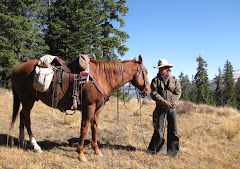
Part IX in the series on Horse Packing How-To: Setting up camp

The first tid bit of advice, coming from my recent experience of doing it alone: work together! Share the work load!

Usually, it’s the three of us (my husband, son, and self) and we all take our respective jobs. It is pretty much the same when just the three of us are out there, or if we have a group of clients we are taking on a pack trip. After unsaddling and turning out the horses, a job which always comes first, the next order of business tends to be to string up a large tarp. The tarp is double duty – it serves as a mantie or cover for the panniers on the pack saddle as well. At camp, the tarp will serve as “camp kitchen,” and sometimes, all we need for sleeping quarters. In stormy weather, it’s a good place to unpack the panniers and sort out the camp supplies, keeping gear (and yourself) relatively dry.

Our two quickest methods for hanging the tarp: One is by stringing a lash rope from one tree to another, using the cinches for tree savers. Run the tarp length wise, centered across the rope, then string out and down all four corners to neighboring trees or to stakes in the ground, creating an instant gable shaped roof line. Method two is stretching and tying off diagonally opposite corners to trees, up high enough to make a comfortable and workable ridge line, then tying off the two other opposite corners to stakes in the ground. This way is fast and easy, though your tarp may not be as high. Even works quite well for one person, as I learned recently.

After the tarp shelter is secured, then the other assorted tasks can be delegated. One of us gathers wood and water, digs a fire pit, starts the fire, and purifies water if need be. One of us sets up the tent, if we are using one, or lays out the sleeping pads and bags and pulls out camp chairs (a great luxury and one of the finest reasons for selecting horse camping instead of back packing!). And one of us unpacks the groceries and starts the meal. I can pretty well guarantee by this time, we’re hungry and tired.

As a single camper, this can seem like quite a lot of work after a day in the saddle, as I learned. However, when we work together, like with so many things in life, we make light work of it. It’s just one small “chore” for each of us, and a good way to stretch out after a day horseback.

And before you know it, camp is set, we’re sitting comfortably by the warm fire, eating a good meal, and enjoying the incomparable view of the wilds in the evening in the high country.

Friday, September 25, 2009

Obstacles along the trail

I learned the hard way about solo horse packing. However, the best thing I learned was that it’s really not so hard.

The biggest obstacle is, of course, fear.

Fear of runaways. What if my horses leave me, run for home, and I get stranded out miles from a road on a trail I probably won’t see anyone on for a day or so? What I found out was that after the first night of being tied up next to my tent and being let out to graze at first light, just the two of them quietly eating next to me sitting on a log with my hot coffee in hand, was that only through trials and traumas like this do we really bond. My horses were there with me, in body and mind. Perhaps it was survival. They were going to stick with me. By the second night, in a new camp, I allowed one to graze untethered. When he became frightened, he ran back to me. I learned to trust them. They were trusting me.

Fear of bears. Probably the most common question folks ask. And truth be known, I slept with a weapon by my sleeping bag, just because of the fears others have instilled in me with these questions. Around these parts, a loud noise (and I can be loud) is enough to scare a bear away. I have done that. I have lived in bear country for years, know how rare they choose a human confrontation, and have even chased a bear away by myself. I should know better than to be afraid of wildlife. Respectful and understanding, yes. Paranoid, no thank you.

Fear of being lonely or bored. Well, I’m a solitary sort. I don’t know if I’ve been bored for more than a fleeting moment in my entire adult life. And loneliness is a state of mind. Alone need not be lonely. I had a loving husband and son back home. That is a security blanket to wrap around any time loneliness may poke its ugly face in the “alone” picture. In the meanwhile, I cherish time alone. And besides: when you’re with horses, you are never alone.

Fear of getting lost. Perhaps this could be a true fear if I was in unknown territory. But I had been on this trail twice in my life. It was not entirely new. More important, I know these mountains well enough from years of working and exploring with my boys. And most important, after spending enough time off the beaten trail with my husband and son, I’ve learned enough about survival that “lost” I suppose is a “more or less” deal, kind of like alone/loneliness. Taking an alternate or indirect route might be a better way to call it. But lost? By now I better be able to find my way around. I suppose this is where preparation, planning, and experience come in. Believe me, I’m not trying to brag here. My experience is still minimal compared to many. But I was not heading out unprepared. I knew what I was doing, and where I was going. More or less.

Fear of people. The stereotypical back country crazy man? My fear of people is tested enough back home with my neighbors. On the trail, however, folks are pretty awesome and friendly. As a rule, I stop and talk to everyone I see. There are some neat folks out there. I try to be “an ambassador for the sport” at each opportunity which arises. I think we all should be. However, the opportunity didn’t arise much. I ran into one man on a motorbike on the first day, and a couple backpacking on the third day. They were, as I expected, great encounters.

Now, what did turn out to be the hardest part above and beyond the fear in my own mind was the physical work. Doing the work that I am used to sharing with three: me, my husband, and our son. Going alone in this respect was HARD. Setting up and breaking down camp, lifting the load on the pack horse, lashing down the load alone, preparing meals and cleaning, gathering water... Riding was easy. This other stuff was hard. I learned a few tricks, and a few things I’d do different next time. First, I want a small pack horse! My days of lifting a fully loaded pannier onto a 15.2 hand horse are OVER. Well, truly, I don’t think I could ever lift 60 pounds alone that high. So, I have these fantasies of a couple of little horses or mules… no more than 13 hands high. In the meanwhile, I learned I could load just a fraction of the panniers first. Then lift that small load on the pack saddle. And then stuff the rest of my load into the panniers in place on the saddle, standing on my tippie toes, or on a stump or rock if available. I didn’t bring a scale, but weighed my contents before leaving the ranch, and kept track of what went in each pannier. I actually kept a list, and this worked well for repacking evenly each time.

Setting up and breaking down camp, including pitching tent, stringing up a tarp, gathering fire wood and water, covering the saddles and gear, etc. took one hour in the evening and one hour in the morning. I reckon next time I’d try an easier tent. Simplify! But I don’t know how to save much time there… except share the work load!

And tending the horses takes about a total of ½ hour in the evening and ½ hour in the morning. I wouldn’t skimp on their care. As they’d graze in the evening, I’d brush them out and double check for any wounds or sores (of which there were none). My one mistake here was that I didn’t pack them any treats. There is plenty of good high mountain grass out there; they did not go hungry. But the extra treat also represents extra care and loving, and my horses would have appreciated that. Goodness knows they deserved it.

See? It was not so hard, and will be even easier… next time!

Monday, September 21, 2009

Going alone

I don’t know why I did it, except for some ceaseless, burning voice inside me, whispering, almost nagging like the wind that I had to go.

In part, I did it for myself. In part for my son. In part for my husband. And a part for anyone else who might be intrigued or inspired by what some middle aged woman born in Jersey might do after living in the wide open wild mountains this long.

It was not a big deal, not a long trip. I planned on four days and three nights. I completed it in three days, two nights. And during that short time, I accomplished all I set out to do. I had all the adventure I set out to find. I achieved all the goals I made for myself. And by returning early, showed my husband and son how important they are to me. Brownie points.

It was certainly not about getting away from them. It was just about proving I could do it myself. All by myself. Something I used to always feel I could do before I got married (that was later in life – I was 35). Something I used to feel before my “little boy” surpassed me in height. Now six feet tall and still growing, I surprise myself to hear how often I ask him to help; how regularly I leave the hard, high, heavy work for him to handle; how much I turn to him now when chances are, I could do it myself.

And then there is the issue of proving oneself. To oneself, to ones family. Not so much to prove strength, ability, independence. No, it is far more than that. More important, I feel, was that I wanted to prove to my son that with proper preparation combined with confidence in ones self, a hunger for adventure, and a trust in faith, in whatever direction ones faith may follow… that one can do anything. We can go anywhere. We can be anything we want. Even some crazy woman’s version of Jeremiah Johnson, just for a few days.

My faith is in my horses. My mountain. My boys. My self, including body and mind strong enough to get me through alone. Mother Earth and her wilds, her wildlife. This is my temple. And so, in a way, I set off to a sanctuary, both within and around me.

It was just a pack trip, a solitary journey covering 40 miles in the mountains we call our Big Back Yard. A distance my boys could cover within hours on motor bike or snowmobile (if allowed into the Wilderness…). A horseshoe shaped path around our ranch. Just me, my riding horse, and my pack horse.

No big deal, I suppose. Yet I feel bigger for it. I feel as if I climbed my own Everest. That’s nothing I’ve wanted to do, but this, a solitary pack trip, was. And I did it.

I tell my husband we can not wait for change. We have to create it. If it comes unannounced, we learn to ride the waves. But in the meanwhile, instead of sitting back on the shore and waiting for the big one, we can dive in and enjoy. Change is all around us, with every ebb and flow. It is what helps us see the magnificence in the sun rise, the beauty in the evening light, the joy in every day, as every day is new, and we too are as new as the hour. If we let ourselves. If we remind ourselves. And sometimes, if we challenge ourselves.

Wednesday, September 2, 2009

A DVD Review of "The Linda Tellington-Jones Series: Riding With Awareness"

Not being one to leave the mountain very often, I have learned a great deal at home from books and DVDs. They have been my horse mentors. All of different names, styles, philosophies, teachings… and from each, I have taken what works for me and my horses, at whatever level I find myself learning at… or stuck at.

After a summer of theory in practice, but little time to sit and watch a DVD, my boys are off to town (getting me, or rather my horses, more winter hay) and I found myself with time… I chose to watch “The Linda Tellington-Jones Series: Riding With Awareness” DVD. This comes with special thanks to Kim from Enlightened Horsemanship Through Touch. Thanks to her Blogging Contest earlier this year, I was able to receive and view this DVD.

Let me start by saying that although I have heard of Tellington-Jones, and the T-Touch for many years, I have not read her books nor seen her speak first hand. From there, I can tell you, I learned it is time I did…

The majority of the material covered in this DVD is not basic, introductory information about the TTEAM approach, philosophy and method. It is assumed (and suggested) that the viewer has essential knowledge of Tellington teachings. I did not, however was still able to get a good deal out of this DVD. In fact, I was so inspired by the bits and pieces I could put together from her very clear and simple teachings, combined with my previous horsemanship knowledge, that after viewing mid-way, I couldn’t resist running out, saddling up my little Arab stallion and trying some new stuff with him. To great result. Then after watching the second half, I can’t wait to saddle up again tomorrow to test out more new methods.

Her teaching made sense to me. The fundamental premise she began with was the statement that everything you do should be as comfortable as possible for you and your horse. If it’s uncomfortable for either one, we (more than likely: me) are doing something wrong. I fully agree, however I do not always figure out the right way on my own.

Her section on practicing hand movements with the reins on an innocent victim (her sister) were so clear that although I could not find a willing victim, I could see the point Linda was making, and you just sort of “feel” the right way as she’s talking and showing you, if you pay attention. Likewise, her simple demonstration of the posting trot, again using her sister here standing up from a chair, was one of those “Duh, why didn’t I think of that before?” moments.

I do not (to refer back to a comment from Jane of the Literary Horse) drink anyone’s Kool Aid, but try to take what works for me, my horses, and my somewhat unusual circumstances of high mountain outfitting with a positive approach to horsemanship. And although I do believe everyone out there has something to teach you if you’re open to listen and learn, there are some people you can see have obvious and great knowledge, skill and insight when it comes to riding, horses and horse handling. I could see Tellington-Jones was one such person, and that I would be smart to take the time to listen to her. I may not want to follow her or any teacher’s direction 100%, but a good teacher I would imagine leaves room for the student to take what works for them and their horses, and put new theory into practice.

For example, although I believe all horses should accept and understand a variety of bits, I prefer riding and refining my little stud with a hackamore, a traditional rawhide bosal and horsehair mecate. Many of the same principles Linda teaches for her roller leverage bit worked wonderfully well with the hackamore.

Well, a detailed review for those already knowledgeable of Tellington’s TTEAM solutions this is not. But for those of us “green” to her teachings yet with a basic knowledge of horsemanship skills, it’s a good step forward in learning, and a good start to understanding the T-Touch and TTEAM systems. I can say it has inspired me to see and learn more from Linda Tellington-Jones… Any more contests coming up, Kim?

Monday, August 31, 2009

Horse Power!

This one is long… but if you have time and any interest in digging, dragging, pulling and plowing with the power of the horse, please take a look at the article I wrote entitled Horse Power at Homestead.org.

If anyone’s been wondering what we do in the high country during the summer season, this will share a little bit of the job with you. There’s more to horses than riding! (and shoveling manure…)

Monday, August 24, 2009

Floyd's Horse Stories: The work horses on the ranch


When I was a little kid, we had one big old tractor on the ranch that had big steel wheels. It was used to pull the plow and to power the thrasher machine. All the other tasks were accomplished with horses. We had about 20 head of horses on the ranch most of the time. That was just the mature horses we relied on for work, not including the mares and colts.

Every year we had from 2-4 colts. Our stud was a big draft horse. Back then, we didn’t put emphasis on specific breeds of the horses. The heavier or draft breeds were primarily work horses, and the lighter breeds primarily for riding. I’ve told you about our mare, Nellie, before (
see link). She’s the one the four of us boys learned to ride on, and who I first rode to school on. Over the years, she had probably six colts.

I’ve also told you a little bit about Ginger (
see link), the first horse that was really mine. I got Ginger when I was 8. He was about 14 hands, a pretty little sorrel gelding with light mane and tail. I thought he was the best looking horse I ever saw. I could entertain the visiting relatives from back east because Ginger would rear up and walk on his hind feet. That was sure to impress them.

At any given time, we had about 5or 6 saddle horses. Dad’s horse was a big sorrel with a star on his forehead called Tony. Dad used him during the summer to irrigate off of. He would ride the horse out into the meadows, which would be all flooded. Dad would step off Tony, drop the reins, take a board out of the head gate or use his shovel to fix a ditch, and Tony would stand there grazing until Dad was done and ready to move on. I would go with him, riding Nellie. Most of what I recall was that the mosquitoes would just about eat us alive.

Now, my Uncle Bill had a horse called Skeeter, and she was a big black mare that also was a very good cow horse and had one very good trait, one very special talent. When we was out checking the cattle, if a calf got across the fence and there wasn’t a gait close by to ride through, that Skeeter would jump the fence, bring the calf back in, and jump back to my Uncle Bill. Pretty amazing. I saw it myself at least two or three times. Uncle Bill would get off the horse; she’d jump that fence, chase the calf back through a hole in the fence, then jump back over and wait for Uncle Bill. You see, he bought that horse from a guy he met at the Stampede fair who was performing a trick act where that Skeeter would jump over convertibles. Well, my folks invited the guy out to the ranch after the show. The guy probably had a hard luck story, but I never heard it all. All I remember was that he was going to quit the circuit for some reason, and told us he was going to come back for his horse, but never came back, so Uncle Bill ended up with her. Well, that Skeeter didn’t have to do any more convertible jumping, but her talents sure came in handy on the ranch

As for the work horses, they’d have their hands full throughout the year, and we relied on them for a variety of jobs. When we were putting up hay, there would be about 14 teams in the field. Besides our own teams, my folks rented horses. Usually the driver and the team would come together; many of them local folks.

So, the full crew during haying involved about 14 teams. The big, heavy work horses were on the mowing machines. There were 5 horse drawn mowers. This was the hardest job on the horses because the sickle is driven by power off the wheels, but the sickle bar was off to the side. The side pull created by the sickle bar would wear on the horse’s neck with the side dragging all the time.

The next hardest job, for which we usually had four teams on, was the buck rakes. These gathered the hay and moved it into the stacker. The stacker team, whose job it was to pile the hay on the stack, had to be a really good team. Not only was the load of hay heavy but the team had to stop at exactly the right time to stack the pile just so. A good team and driver could place the hay either in front or back of the stack, and make the job of the men on the stack that much easier. Each pile would be kept nice and square with a rounded top.

Then, there were five teams on the sulky or dump rakes. These were usually lighter weight or smaller horses because it didn’t require the power to pull that many of the other jobs did. One team I particularly remember were a set of big bay mares we called Mini and Mandy. They were the stacker team during haying, the feed team during the winter, and when they were feeding cattle, why they would pull in beside the hay stacks, while the hay was forked onto the wagons, then pull out into the herd of cattle. The driver could tie the reins around the post on the wagon as the team would drive out, make a circle, and be back when the hay was unloaded. Early auto pilot.

We had two hay wagons, one that fed the cattle, one that fed the sheep. All winter long. 300 head cows would be fed. That required 3 loads of hay. The same was needed also for the sheep. So, both wagons would leave out soon after sun up, and wouldn’t be done until 2. On Saturday, they fed double, so it was an all day ordeal. But then Sunday was a day of rest.

The same horses were used for the farming operation, for disking and harrowing, planting and pulling the binder (a machine which cut the hay and put it in into bundles), then pulled the bundle wagons that hauled grain to the thrashing machine. The thrasher made a big straw pile as it threw straw out the back end, and grain out the side to a little box wagon.

When we were haying, you were expected to have your team harnessed and ready to head to the field at 7 am. Everyone took one hour off for lunch, during which time the women folk brought a hot meal out the hay field. The teams were unhooked and tied to the fence or the equipment, and given a fork full of hay for their own lunch while the people ate. At 1 o’clock, the teams were hitched back up, and the whole crew worked on the field to 6. After that, those of us who drove rakes still had to unhook the rake and ride the horse back to the barn. The mowers were the only ones who rode the equipment back in, as they had to change the sickles and grease the moving parts regularly.

When it was time to break the work colts, we took the big stud horse, and teamed him up with a new horse. We’d then hook the two of them up to the breaking sled, which was just a wooden sled with a tongue. On top of the sled, we’d pile sacks of sand for added weight. Well, no doubt that stud knew what he was doing, and he let the new horse run away and pull the whole weight of it. As you can guess, it wasn’t long before the new horse learned to let the stud take on his half of the work. And if they wouldn’t pull their half, he’d pull the sled right up into their heels to keep them going.

We’d drive them up the lane, turn around as the stud would push the young horse around, and drive them back. And do it again two days later. That’s about all it took with these horses. That stud was the teacher really.

There was a lot of work for the horses, and a lot of work for us all. Three meals a day were served for the crew. The crew included our family of 7, then my grandparents, Uncle Bill, the two maiden aunts, Clara and Amelia, and somewhere between 6 and 12 helpers. There were three men that were our regular help, who lived with their families nearby but would join for the noon meal. But throughout the year, for sheep shearing in the spring, haying in summer and thrashing in the fall, there would be more hired hands to help, and to feed. For most of the crew, there was a bunk house over the shop. They’d bring their own bedrolls, and sleep on an old army cot. Before meals, they washed up in the basement in my grandpa’s house.

Providing regular meals for all these people was a lot of work for the women folks, but that’s another story…
Story by Floyd Getz, Photos from the Getz family archives.

Wednesday, August 19, 2009

Part VIII in the series on How To Horse Pack: Arriving at Camp


This may not seem like much of a topic, but after remembering how stressed I’d be on the trail, right before arriving at camp, thinking about how to handle who and what first and how… I’ll hope I’m not the only one who might have appreciated a little advice on what you do when you get to the camp site.

It’s this very reason that I’ve envied back packers (mind you, however, I am an avid and true blue horse packer). They arrive at camp, drop the load from their back, and sit back and rest a while. Then lay out their tent or bivy sack, heat up the water for their dehydrated dinner, and call it quits. OK, I don’t know if this makes up for the burden of carrying 70 pounds on your human back all day, but it’s the compromise. We horse packers don’t have the load, but once we get there, the work is far from over. (Oh, and in further defense of the horse packer – yes, you can tell I’ve been in this debate more than a few times – “sitting in the saddle” all day is far more than just sitting… Let me know what you think after you’ve spent 5 hours or so in the saddle in the mountains one day.)

So, what do we do when we arrive at camp?

Well, first of all, the horse comes first. And usually we have a few horses to care for. So, there’s work to be done.

When we arrive at a location we plan to set up camp, the horses need not be too close to camp. Remember, once they stop and relax, they’re more than likely to be needing to relieve themselves (probably the rider will be too), but no one needs that where you’ll be pitching your tent. We find a group of trees just far enough away from where we’ll be setting up camp that it’s easy to lead over the pack horses one at a time to unload, but odors will not be offensive.

Usually by the time we reach camp, the horses are tired and hungry (once again, probably the rider will be too). I stop, drop the lead rope of the pack string, drop the reins of my riding horse, and chances are more than likely that they’ll all do nothing more than lower their heads and begin to eat. As a probably obvious tip here, make sure you stop in a grassy location. The horses are more interested in eating and resting than running off. This gives me time to dismount, remove my horse’s headstall, hang it over the saddle horn, and clip on his lead rope; then take off my hat and chaps, which I usually just hang over my saddle; and untie the pack string.

Bringing the stallion to camp adds a little extra caution. I’ll drop his reins and let him graze, only long enough to remove his bridle, and clip on a long lead rope which I can picket to a stump or rock or bush if need be, to keep him at a safe distance from fighting with the other horses. But since he’s a skinny boy, I’d like him to be grazing as much as possible when he’s not working. You can use this trick if you have a horse that fights, bites, kicks, or runs off.

Then, each pack horse is led over closer to camp, and their load is lifted, unloaded under a big tree in a neat pile. Sometimes not so neat. But it’s all there. All the fixings for setting up camp in one big pile. We can take care of all that later. First, the horses. One by one, the horses are led over to a good sized fallen tree (in our neck of the woods, these are plentiful) that works as a great saddle rack. There, each horse is unsaddle, inspected for chafing, wound or saddle sores, briefly curried, and sprayed with fly spray if need be.

After each horse in unsaddled, they can either be tied to trees (high and tight) for a short period of time if this is permissible in your location, or better yet, set up your highline with tree savers (or cinches) right from the get go, and tie the horses safely up there.

The saddles are left uncovered to air out if it’s not raining, but we don’t forget to cover them before night fall, throwing one of the pack tarps over them to protect them from rain or snow, frost or dew.

After the last horse is unsaddled and tied up, we usually leave the horses tied and resting while we address the unpacking of the panniers and the setting up of camp. A little bit of down time for them won’t hurt, though we know what they really want is GRASS.

So, after camp is set and our personal belongings are all in order, before we can sit down and relax (or eat… and I’m usually pretty hungry by now, so keep those snacks handy), the horses have to be turned out to graze. I’ve address how we do this in a previous post.

When the horses are all turned out and grazing, and all stock seem well and fine, and the camp is set… then and only then can we sit and relax. But since we didn’t have to limit our gear to what we carry on our human back, and had our horses help instead, chances are we packed a chair, and now we’re sittin’ pretty!

Sunday, July 26, 2009

Natural Hoof Care and the Barefoot Horse


I’ve never been one for medicines and doctor visits, for myself, my son, or my horses. I have this underlying trust in beings that for the most part we are strong, healthy and have what it takes to remain so. Yes, I do know this is not always the case; life always keeps us on our toes, perhaps so we take nothing for granted, can appreciate the goodness of nature when things do go according to plan, and become stronger by handling the challenges life throws at us when things do not. The ability to turn to modern medicine has been a blessing, in fact enabled me to still be alive today, but not one I take lightly, or expect to rely on with every given ailment.

That said, you can see I tend to prefer more natural approaches to health and care of self, family, pets and animals. All the way down to their feet. I’m talking about, of course, natural hoof care for horses, or keeping horses in their natural state of being barefoot, without steel nailed onto and through the hoof wall.

The practice simply makes sense to me. As a young girl, I was able to run barefoot myself for summers on end. My feet toughened to the point of tolerating walking on glass and hot pavement, or hiking across rock and gravel. Today, I haven’t been out of the house barefoot in years, and would have trouble walking from here to the barn if I were to attempt it barefoot. I know I’m capable of getting tough again, but right now, those digits are softies.

Why can’t it, why shouldn’t it be the same with my horses? We leave them barefoot all winter without problems. But heavy use, regular work, hard trails, mountains and rocks added to the picture make it a blur of confusion. It could, should, might work…

I started by attempting to hire a barefoot trimmer for consultation. Due to our remote location, after a year of correspondence, I was still without an appointment. Anyway, we are lucky enough to have a farrier with an open mind, willing and able to learn and try natural hoof care trimming, for our sake, and for the sake of our horses.

We then did a bunch of research on the internet and learned there are about as many styles and philosophies on barefoot trimming as there are horse colors. Believing inherently that bottom line, nothing should ever be done that hurts the horse and makes him lame, the more drastic approaches were not for us.

After reading Pete Ramey’s book “Making Natural Hoof Care Work for You,” I felt I found a logical approach that would work for me and my horses. When we pulled their shoes last October and had our farrier trim throughout the winter, we felt we were on the right path.

Then the summer season happened, and as usual, it starts with a BANG and continues rattling clear through autumn. We rarely have a chance to breathe, let alone slow down. For the horses, this means time to hit the trail, and get out their regularly. There is no time to be lame, to be soft, to take it easy, to test the waters. No time to sufficiently toughen up.

And sore they did get. I tell you what, as a horse lover, let alone one who relies on horses for their business, seeing my babies sore because of my choice was a pretty tough place to be… talk about questioning yourself, your motives, your choices…

Then one day, I had a long trip scheduled on one of the rockiest trails I know in this area, which for those of you who know the San Juan Mountains, know that’s saying a lot. And my main mount, my guide horse was sore. Sore because of my decision to “try” the barefoot horse thing.

So what did I do? I turned to my back up. Another barefoot horse. One who was not sore. My little stallion, Fadjurz Ideal, otherwise known as Flying Crow. At age 7, he has never been shod. I trim his feet myself. He gets plenty of exercise (as do so many stallions on pasture, even during his free time he seems to enjoy running back and forth for hours on a path he has packed hard).

I had never guided on him before, nor ridden him on this trail, thus was more than a little apprehensive. But life throws challenges at us at times when the timing must be just right. I rode him, there and back, a full day in the mountains in some pretty nasty conditions, and you know what? We haven’t looked back since. His feet were NEVER sore from that day. Nor from the many days since that I’ve continued to keep him going on the trails with me, working and guiding.

He made a believer of me. A horse can be barefoot. In fact, a horse can thrive barefoot. The footing, the health benefits, the ease of care… it all makes sense to me, and it all can work. But it takes effort to make it work. Commitment. Time. The right conditions. Plenty of rides to allow the horse the opportunity to toughen up. Flying Crow was sore once too… about four years ago when I first brought him home from the stable in which he was raised, and turned him out on pasture. It has taken years. But it worked.

I do not doubt that this would work for all of my horses if I rode them as regularly all year long, and had them as active as my little stallion. I never manage to have all the time I wish I had for each of my horses. When and if the day comes that I do, and believe I’m working towards this, I feel certain I can prove this a success. I will be providing what I truly believe is the healthiest hoof care for my horses by keeping them barefoot.

In the meanwhile, I have my Flying Crow, barefoot and fancy free, running around the mountains with me, naturally. Reminding me (and you) that this can work. It does work and it is working. A horse can thrive barefoot, even in these conditions, in these mountains, with all this riding…

If you have any barefoot stories, ideas, suggestions or experiences to share, please leave a comment or write me directly at losttrailranch@gmail.com. I’d love to learn more and look forward to many a barefoot tales to follow…

Sunday, July 19, 2009

Lessons learned from a little stud horse

We’re finally working together, my little stud horse and I. I mean really working. Guiding rides, and riding up the mountain to our camp in the Wilderness where we work mid-week, picketing, high line, the whole nine yards for the life of a working mountain horse. As well as giving us some lovely colts…

It took us three years to get here. I often think it should have taken us three months. I suppose if I knew then what I know now, it would have been so much easier. For both of us. But it was all these lessons we learned together that got us to this point, and gave me the knowledge to do so much better… next time. In the meanwhile, he forgave me for all my mistakes, and helped me learn the right way; showed me what I needed, and is still teaching me plenty most every day.

The biggest lesson he taught me I think I only now finally get. That I need to be a good leader first, and a good friend second. Just loving him and caring for him and being nice won’t get us up the trail safely. I wished it would. I tried that for years. But he needed a leader. And once I learned to be strong and firm but fair, to be a good leader, then and only then did he really want to be my friend. Before that, I see now, our friendship was on his terms, and at my expense.

I could ask ten times. That is no longer asking. That is nagging. Horses know how to tune that out like a child of an irritating mother. I didn’t raise my child that way. Why couldn’t I treat my horse with the same respect I treat my son? I ask him once. If he doesn’t get it, I figure either he didn’t hear me, or I perhaps I didn’t communicate clearly. I may try again, a little more firmly. If I have to ask a third time, he knows I’ll demand a response, and rightfully so. It should only take once, if done right. I know how to talk to my son. It came easily to me. I treated him with the leadership I wished I received as a child. Not just friendship. But true leadership. Direction. Help. Protection. Because I care about him. I love him, and he knows it all the time. I may not play with him or be a soft and warm and fuzzy mother. He says I’m like the mama wolf, and he knows he’s safe, and he knows if I ask once, I mean it. I may not ask a second time.

Finally, I am learning to treat my horses with the same care and respect. If I care about them, I will be their leader. With love, and kindness, and strong protection. I will ask only once nicely.

Finally, I am learning to be the leader he has been looking for. Now and only now, can we truly be friends.

Monday, July 13, 2009

Part VII in the series on Horse Packing How-To: On the trail

As we head out again to the high country with our horses, this is the season to be amassing notes, photos, information and ideas to share with you at a later date and a slower time. And stories, including Floyd Stories… Ah, the ebb and flow of life. It’s flowing now. Lots of fun, and never enough time to do all we wish to accomplish on any given day. A good feeling, to have so much you want to do, you enjoy doing, you wish you could do…

In the meanwhile, a brief set of notes to share with you on horse packing. These on the actual how-to on the trail.

First of all, it sure helps if your riding horse or mule neck reins and doesn’t mind a rope under the tail. Most horses (and almost all mules) are surprisingly undisturbed by a rope rubbing under their back end and will completely ignore this, or perhaps clamp down their tail briefly. I don’t think I would like it much, so the few that do over react, and a few will, I give them time; they’ll accept it eventually.

Next, if you are leading more than one horse or mule in a pack string, take care to tie them together safely. We use a “pigging string,” a piece of bailing twine looped over the front brace of the cross bars in the pack saddle before packing the horse, and hanging out the back end of the pack over the horses rigging along their back. The lead rope of the following horse is then tied onto the pigging string. (This works well too for leading a group of saddle horses – just loop the pigging string over and under the saddle horn and be sure the cinches are tight.)

The pigging string serves as a release point in an emergency, such as a horse slipping down trail. Better to allow a break point than lose your whole string. The horse’s safety matters to me. I figure I have no right being out there working with my stock if I can’t care for them in a safe and sound manner. Pack extra bailing twine. It can snap en route. Replace it as needed. Anyway, you all know how many other uses you’ll find for string in camp if you don’t use it all getting into camp…

We tend to tie the lead rope on long enough that the following horses can put their head down to drink at creek crossings if need be. We’re often out there for long hours, and our stock work hard. For short trips, you may consider tying shorter – not so close that the horse will ride up on the horse in front, but not so long that the horse can put his head down and graze as he moseys down the trail.

Finally, the most important part is caring for your stock on the trail. I once read that a truly good packer rides looking backwards half the time. I strive to do this. I try to gently hold my riding horse up as needed at creek crossings, bridges, rocks, and other obstacles in the trail. Make sure the string all find their footing and safely cross. Keep an eye on the stock to make sure they are not being dragged along or pulling back, and that they are staying in line. The order of your stock in the pack string is essential. A bossier horse will work great in the lead to keep others in line behind, unless he or she kicks, then that one needs to be at the end of the line… unless he or she bites. Get to know your stock. Find the order that works best for them. Allow them to be happy and comfortable. I don’t want my horses grumbling and uncomfortable in the pack string. It is work, but not a bad job. They more content the stock is doing their job, the easier my job is, of course.