Showing posts with label the health and care of our horses. Show all posts

Thursday, December 3, 2009

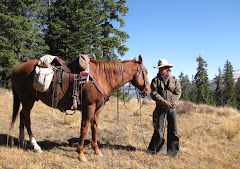
A modest proposal in praise of rope halters

Recently, I read an article putting down the rope halter and comparing it to, seriously, a torture device. First, this made me roll me eyes. Then it made me a bit angry. I know my horses. I live and work with them. When I put a rope halter on them, I can promise you, they are not being tortured.

Being outfitters, we often leave our halters on beneath the bridle so that when I arrive at a fishing location, a picnic spot, or at camp, I can jump off my horse, clip on light lead ropes to each of the horses halters, secure the horse safely to a tree and slowly unbridle, loosen the cinch or unsaddle as necessary. I have the safety of many horses, and riders, to attend to quickly. It’s a practical, although I have been told, rather unattractive practice most outfitters choose by necessity. We may be a rough breed, outfitters, but we are practical, and those I have known, care for their horses, and know their horses, as well or better than those calling this practice ugly. Our horses are not only our passion, they are our life.

The rope halter, under the bridle, is far lighter and less distracting for both horse and rider than the heavy nylon web halter. In addition, if one claims this “torture device” is so powerful that a horse would be hurt should he or she pull back, well then, in my job, that’s fine. Don’t pull back. However, I’m afraid I haven’t found them that effective!

I am certain there are pros and cons to all kinds of halters, out of all kinds of materials. I do believe it all comes down to personal preference, and knowledge of use and handling. I would like to keep an open mind, and to use what works best for me and for my horses. I would not like to condemn others for using something different. This would only prove my ignorance. It is he who talks the most who knows the least. (Stop me before I go on too long!)

Regarding calling the rope halter a torture device, I can not say I have seen this to be true, however I can say this: the same argument has been used against all kinds of tack – from a leverage bit, a spade bit, hackamores, spurs, riding crops… you name it.

There is no replacement for good horsemanship. No tool will make us handle horses better. Or, I believe, worse. Only through our own growing knowledge of the horse and improvement of our communication skills will we be better horsemen.

So you can blame the bit, or blame the bridle, or blame the halter. Me, I’ll blame the handler. And I’ll take the blame if I am torturing my horses. But when they run to me and turn their head softly towards me as I ask them to slip on their halter… somehow, I think torture may not be the right word.

Here was my response to the finger pointed at the halter:

“Is it the tool or the handler? Any tool can have harsh results in harsh hands. Likewise, lightness from the so-called harshest of tools flows from light hands…
I make my own …they are cheap, light and handy, quite comfortable for my horses... for my use… they work for me. I work well with them. I think it's not the tool, but the handler. Likewise, with spurs, leverage bits, etc. Perhaps for folks assuming rope halters are 'natural' and therefore, only gentle, we should remind them that they, like any tool, can be harsh and cruel if used improperly. Know your tools. The best of horsemen can learn to use any tool with lightness. Rather than rely on a tool, rely on a touch.”

Sunday, July 26, 2009

Natural Hoof Care and the Barefoot Horse


I’ve never been one for medicines and doctor visits, for myself, my son, or my horses. I have this underlying trust in beings that for the most part we are strong, healthy and have what it takes to remain so. Yes, I do know this is not always the case; life always keeps us on our toes, perhaps so we take nothing for granted, can appreciate the goodness of nature when things do go according to plan, and become stronger by handling the challenges life throws at us when things do not. The ability to turn to modern medicine has been a blessing, in fact enabled me to still be alive today, but not one I take lightly, or expect to rely on with every given ailment.

That said, you can see I tend to prefer more natural approaches to health and care of self, family, pets and animals. All the way down to their feet. I’m talking about, of course, natural hoof care for horses, or keeping horses in their natural state of being barefoot, without steel nailed onto and through the hoof wall.

The practice simply makes sense to me. As a young girl, I was able to run barefoot myself for summers on end. My feet toughened to the point of tolerating walking on glass and hot pavement, or hiking across rock and gravel. Today, I haven’t been out of the house barefoot in years, and would have trouble walking from here to the barn if I were to attempt it barefoot. I know I’m capable of getting tough again, but right now, those digits are softies.

Why can’t it, why shouldn’t it be the same with my horses? We leave them barefoot all winter without problems. But heavy use, regular work, hard trails, mountains and rocks added to the picture make it a blur of confusion. It could, should, might work…

I started by attempting to hire a barefoot trimmer for consultation. Due to our remote location, after a year of correspondence, I was still without an appointment. Anyway, we are lucky enough to have a farrier with an open mind, willing and able to learn and try natural hoof care trimming, for our sake, and for the sake of our horses.

We then did a bunch of research on the internet and learned there are about as many styles and philosophies on barefoot trimming as there are horse colors. Believing inherently that bottom line, nothing should ever be done that hurts the horse and makes him lame, the more drastic approaches were not for us.

After reading Pete Ramey’s book “Making Natural Hoof Care Work for You,” I felt I found a logical approach that would work for me and my horses. When we pulled their shoes last October and had our farrier trim throughout the winter, we felt we were on the right path.

Then the summer season happened, and as usual, it starts with a BANG and continues rattling clear through autumn. We rarely have a chance to breathe, let alone slow down. For the horses, this means time to hit the trail, and get out their regularly. There is no time to be lame, to be soft, to take it easy, to test the waters. No time to sufficiently toughen up.

And sore they did get. I tell you what, as a horse lover, let alone one who relies on horses for their business, seeing my babies sore because of my choice was a pretty tough place to be… talk about questioning yourself, your motives, your choices…

Then one day, I had a long trip scheduled on one of the rockiest trails I know in this area, which for those of you who know the San Juan Mountains, know that’s saying a lot. And my main mount, my guide horse was sore. Sore because of my decision to “try” the barefoot horse thing.

So what did I do? I turned to my back up. Another barefoot horse. One who was not sore. My little stallion, Fadjurz Ideal, otherwise known as Flying Crow. At age 7, he has never been shod. I trim his feet myself. He gets plenty of exercise (as do so many stallions on pasture, even during his free time he seems to enjoy running back and forth for hours on a path he has packed hard).

I had never guided on him before, nor ridden him on this trail, thus was more than a little apprehensive. But life throws challenges at us at times when the timing must be just right. I rode him, there and back, a full day in the mountains in some pretty nasty conditions, and you know what? We haven’t looked back since. His feet were NEVER sore from that day. Nor from the many days since that I’ve continued to keep him going on the trails with me, working and guiding.

He made a believer of me. A horse can be barefoot. In fact, a horse can thrive barefoot. The footing, the health benefits, the ease of care… it all makes sense to me, and it all can work. But it takes effort to make it work. Commitment. Time. The right conditions. Plenty of rides to allow the horse the opportunity to toughen up. Flying Crow was sore once too… about four years ago when I first brought him home from the stable in which he was raised, and turned him out on pasture. It has taken years. But it worked.

I do not doubt that this would work for all of my horses if I rode them as regularly all year long, and had them as active as my little stallion. I never manage to have all the time I wish I had for each of my horses. When and if the day comes that I do, and believe I’m working towards this, I feel certain I can prove this a success. I will be providing what I truly believe is the healthiest hoof care for my horses by keeping them barefoot.

In the meanwhile, I have my Flying Crow, barefoot and fancy free, running around the mountains with me, naturally. Reminding me (and you) that this can work. It does work and it is working. A horse can thrive barefoot, even in these conditions, in these mountains, with all this riding…

If you have any barefoot stories, ideas, suggestions or experiences to share, please leave a comment or write me directly at losttrailranch@gmail.com. I’d love to learn more and look forward to many a barefoot tales to follow…

Thursday, June 11, 2009

Always something...

As those of you who have horses may have come to believe, if it can go wrong, it will. Careful as we may be, we can prevent most problems, but new challenges present themselves regularly. Horses have a way of reminding us to be present, to pay attention at all times, to only let your guard down in limited doses, and to always be prepared for the unexpected. Our beloved equine companions have become for us loving half-ton bundles of lessons in learning to deal with the many surprises life has to offer.

This is about the latest lesson in learning to handle the unexpected. And it’s a pretty beautiful story in the process.

Our lovely mare Willow, a 10 year old Fadjur bred Arabian mare we brought home from the Jack Tone Ranch about 3 ½ years ago now, birthed a precious little colt early in the morning yesterday. I’ll share my birthing notes at a later date – hopefully as a help to someone out there, but at the very least, as record for me. This was Willow’s third baby. She’s a beautiful mother to watch – so protective and alert in her never failing care.

Anyway, this colt is a cutie. A little elf of a fellow. Quite the contrast to his especially graceful dam, though I am certain he will one day blossom into the lovely swan. He’s got these LONG legs, I mean LOOOONG. So long, in fact, that he has no idea how to lie down. It’s a long way down from up there. And these legs are simply unruly. What’s a colt to do?

In this case, the answer seems pretty clear to this little fellow. Just don’t lie down.

But boy-oh-boy does he get sleepy, and little foals have not mastered the art of sleeping standing up very effectively. So he’s been tired, so tired…

We tried to lie him down. He’d pop right back up, as quick as those gangly legs would manage. Even when his mama and the other mare and foal are flat out and sound asleep in the afternoon sunshine. Nope, he just wouldn’t lie down.

Finally yesterday afternoon, we figured out the secret weapon to battle his exhaustion and conquer his fears. Beka.

See, if we lie him down, and Beka gently holds him and stays there with him, he’s more than happy to fall into a deep sleep. What little one wouldn’t be content sleeping in someone’s loving arms? Last night, it took him less than a minute, and Beka was stuck remaining there for over an hour as the rest of the horses decided to lie down all around her. This morning, perhaps it took a full minute before he was sound asleep, as Beka sat with him in the wet grass, with the content mother looking over.

I’m sure he’ll learn eventually, but in the meanwhile, we figure sleep is pretty important, especially to a little guy. And we’re pretty grateful to Beka for her patience and gentle care that baby and mother are obviously most comfortable with.

Spoiled? Maybe. Who cares? We’re glad to do whatever it takes to keep our little ones healthy and happy. Why not?

Anyway, Bob’s been lying the baby down by reaching over him and pulling his legs up and over like a calf at a roping. The colt ends up in Bob’s standing lap, and he gently lowers him. Baby better figure things out fast, because I don’t know how much longer Bob will be able to do this! And likewise, how much longer Beka will remain so loving and patient…

In the meanwhile, if anyone knows a better way to safely and gently lie a foal down, please drop me a note.

So, there you have it. Who would have guessed the simple act of lying down would be such a big problem? Such is life with horses…

Would we want it any other way? No. And learning to work with our horses, we then slowly learn to handle our children, our spouse, even ourselves… whatever life throws at us, in the most positive approach possible. Learning to deal with whatever comes up next in the best manner we can. We do what needs to be done, and learn to love the journey more so than some goal or final destination.

Sunday, May 31, 2009

Birthing notes

I am delayed sharing birthing notes for our latest foal, born on the morning of the 24th. The delay is intentional. After all the sadness and pain from losing our last one, I have been scared. But scared or not, life is good, and I can’t stop living and enjoying as much as I can because of fear. I’ll do my best to take that to heart for foaling, horsemanship, and every aspect of my life.

Today the proud new Parents (well, at least Owners) of our new foal came to meet their baby, and something inside me started to accept that we have to trust, to believe, and to hope for the future. This little boy is going to have a wonderful life after weaning this fall…

In the meanwhile, a brief sharing of my foaling notes:

6:15 am on a wet and foggy morning. Checked mama Canella’s teats for signs of waxing. None visible. Mental note to self: it’s too muddy to notice waxing! I should wash her teats tonight. Canella is a young Quarter Horse mare, born here at the ranch. This will be her second baby.

9:15 am at the kitchen table doing Spanish lessons with Forrest and I keep looking outside at the pasture fence. Canella is not off grazing with the other horses, but is standing by the fence looking up at the house. She’s calling me! I excuse myself from school, grab a halter and go out to get my little mare. When she sees me, she lies right down. I get her up, and get her off the main pasture, and into our back yard.

9:35 am the baby is born. Last year the baby began to be presented high, through the rectum, and would have torn mama severely but we were able to reach in and reposition the presentation. Mama is a year older now, and the presentation was perfect, the little foal in the diver position, both feet slide out well. Floyd (yes, the Floyd of the stories here!) chose the perfect time to visit, and helped with traction, pulling downward with contractions to help the little mare who was having a bit of trouble getting the shoulders through the birth canal. I opened the sack when the head was fully through, removed mucus from the nasal cavity, and waited as the baby took a minute or so to breath. A healthy young boy presented himself!

He was up on all four within the hour, (Bob took a video clip of this if you'd like to see on YouTube) but finding the teats took a bit longer. After three hours without success, Bob and I milked out the mare and bottle fed baby to ensure he received colostrum in a timely manner. We bottle fed him ever 1 – 2 hours all day long, probably a total of 15 oz, until we were certain he was latching on to mama. By 6 pm, we were confident he figured it out! Baby’s navel was dipped in iodine directly after birth, and two additional times within the first 24 hours. A dose of ProBios was administered at 4 hours old, then additionally for the next 4 days.

Up until today, he’s been called “baby” or Twinkle Toes because of his one white foot which looked golden to my Mama J. Today he’s officially named by his new owner: Fadjurz Ascension. Nick name: Cricket.

Welcome to the world, Cricket. May it be a wonderful life for you.

The owners of Cricket are Patti & Creed de Avanzar of de Avanzar Arabians.

Friday, May 22, 2009

Your veterinarian: considering the choices

You’ve probably already considered this topic, but since I’ve been through (far too) many vet visits as of late, I am reminded of the importance of establishing a relationship with a veterinarian.

For many, our choices are limited because of location. The closer the vet, the better, as far as emergencies go. More often than not, we are visiting the vet because of emergencies, aren’t we?

However, if you have a choice, consider your options. I’m rather trusting in believing that any vet is going to know far more than I ever will about animal health in general. The intensity of their studies and practice does pay off… And their expertise is irreplaceable.

I can change the oil in my truck and change a flat, but I can’t repair the motor or replace the clutch. I have a good mechanic I trust for that. Specialty service. Trust in the experts. I wouldn’t ask my mechanic to bake me a loaf of bread, clean a rental cabin, or take my guests out for a horseback ride.

So, considering every vet will be in the practice he or she is in because of such specialty knowledge, topped with years of focused experience, we can assume the vast majority are good, and do it because they care about animals. I don’t believe you will go wrong with you choice.

We then can look more closely, and make our choices based on person preferences. Do you like how your vet handles and treats your animals? What could be more personal? If not, keep looking! I can’t imagine anything more important. If your animals are important to you (and I am pretty sure if you’re reading this, that’s a given), why would we accept a vet would doesn’t treat our animals as we want them cared for? The vet I have chosen for our dog and cats I believe truly cares for them. And you can see it, as my critters are pretty comfortable in his presence. My dog is actually happy to visit our vet. That tells me a lot.

Horses are the same way. I have a different vet for our horses, because I am starting to put a great deal of value in continuity. In all my recent disasters, I got tired of telling the same story over and over. So, I’d like to stick with one, and to have her get to know my horses. I like the way she handles them. I imagine her knowledge is no better than the next vet, but her handling is in line with how I want my horses handled.

I believe that every time we interact with our horses, we have an opportunity to improve our relationship with them. We can use every opportunity as a chance for positive training. Even the vet visit. Yes, I know, they can just get it over with and get over it. Chances are, they’ll be OK. But… consider this: if the vet visit is a positive experience for the horse, don’t you bet your horse will be better about handling next time? Why wouldn’t you want to take every opportunity you had to work on a more positive relationship and knowledge base?

Consider again the ongoing relationship. I had been in a situation whereby the working horses were rarely taken to a vet, and if they were taken, it was based on convenience, who was available at that time. As a result, the horse (and I) rarely saw the same vet twice. But isn’t it nice to know you can call up or bring your animal in, and know the animal (and you) will be remembered? Saves a lot of repeating the same history over and over and over… I’m guessing that from the vet’s perspective, this continuity also makes their job a little easier.

For those of us who live remotely, this relationship with a vet who has knowledge of you and your animals is essential. I used to manage a much larger herd of horses (though my luck defiantly was a little better back then). My vet and his assistance would come out once every fall, spend the night, and take care of all our horse needs in those two days. Preg checks, geldings, teeth floating, etc. The rest of the time together was in “consultation.” He’d show me what I’d need to have on hand, and how to use it, so that for the rest of the year I could call him up (yes, I did have phone service back in those days), report the signs and symptoms, and get the best advice possible based on his knowledge of our horses and our facilities, and my knowledge of the information and medications he’d refer to. He would charge for the phone consultations, but would not have to take the time to drive all the way out to our ranch, which at the time was over two hours from his office. It was a win-win deal. Or rather win-win-win. The vet, me, and the horses.

Believe me, I’m the first to wish I knew it all when it comes to horse health. But my recent disasters have reminded me otherwise, and also opened my mind to anyone’s claim to know all the answers. A vet who admits to not having all the answers is probably the wisest. A neighbor who claims to know it all is probably not.

Friday, April 17, 2009

Dealing with death

There were other things I planned on writing about today, but such is life, things have changed, and this is a timely topic. Death. As horse owners, it is one that we already have or will eventually have to address. It is one that over the past two years, have had to address all together too often, thank you very much.

Five deaths in two years.

We started by putting down two of our older horses. One was in her early or mid thirties, and had an awesome life living and working up here on the mountain. She was my son’s babysitter when he was younger, safely carrying him on some of the steepest slopes and challenging trails. She had been retired for a couple years, and I believe was beginning to feel as poorly as she looked, with the old sway back, and hip bones and ribs you could see clear around.

The other was in her twenties, and had an injury to her back leg that fused up in healing and created a growing limp that we learned would not heal, and would not go away. This mare was my dad-in-law’s mount for many a mile and many a year, and for the last two, he had allowed my son to ride her as well.

Then the unheard of happened. Last spring I lost a four day old foal. I don’t want to go into all of this here and now. If you’re interested, I have a detailed post you can see by clicking here. But I will just say that I never believed this could ever happen, at least not to me. And when it did, it was harder to deal with than any horse death I have endured over the years.

Earlier this spring, a two year old filly was found dead on winter pasture. Cause of death was unknown. No one was there to help her or to find her. My husband found her on his bi-weekly trip to town when the filly had probably been dead for a week.

I know for years, people around here just turned their horses out on a winter pasture and let them fend for themselves. For anyone who thinks turning horses out to fend for themselves is “fine,” well, great – it’s fine for you. I don’t like it. I never have and have tolerated it unwillingly. And unfortunately, my fears and worries proved justified. It has cost lives. I lost this filly that I more than likely could have helped if I had her up here with me. Just the day before yesterday, we checked our horses again on winter pasture, and found another two year old in a bad way. As luck would have it (and believe me, having luck feels very unusual, but I’m mighty grateful for it this time!) we were there to see it, had the vet out immediately, and were able to save him. But we were not as lucky the following day. And not due to lack of care and attention this time.

Yesterday, I lost a two week old filly that I thought I had “saved.” I mentioned the ordeal we went through with her during her first week of life in an earlier post.

Nope. After a week of doing great and showing no signs of anything but vim and vigor, she died in my son’s arms as I was in town. My husband is in back in town now with the body so that our vets can perform an autopsy.

Taking care of a herd of up to 42 head for several years meant I dealt with many deaths. We would average one a year. Our horses averaged living to a ripe old age of 30, so I suppose this was an acceptable figure. But now, with a herd of about 15, losing one a year, or two… or more… is wrong.

I am working on it. I am doing all I can to learn why and how and what all can be done. I believe one of the most useful things we can do is to have that autopsy done on the dead animal. It may seem gruesome, but I believe the information we can receive from this is invaluable, not only for us, the owner of other horses we need to try to keep healthy, but for the veterinarians and for the horse industry in general. Only 25% of deaths in foals are figured out. Why? Probably, we don’t take the time and money (and pain and grief) to find out. I need to know. I want answers. I have four more foals due this year, and I am not going stop breeding and raising foals just because of two terrible years. I will learn and look back on these years as the nightmares that they are, but I will have knowledge to move forward, have healthier horses, and hopefully share knowledge to help other horses and horse owners as well.

So here you have five examples of death. Some timely. Most untimely. None are easy to deal with. So how do we deal with it?

I am doing it now. I get mad, so I learn and study and that helps me understand, which in turn helps me accept. I reach out. Because every horse owner knows what this feels like. I cry. I feel it. I don’t pretend or deny it. And I remember that this is part of life. Not a good part, but it’s that package deal. And the practical nature takes over. A survival mechanism. We have to get up and take care of the other horses. We have chores to do, job to do, children to feed, other horses who need us. We get over it and get on with things best we can, though he pain stays with us. It can haunt us at times, for months or years, especially with the untimely deaths. I think we need to not run from the pain, but accept it somehow.

I don’t know how yet. I guess it's different every time. Every horse, every person, every day. It is still too new right now. I will let you know how it goes.

As one reader wrote in on another post:

“As a Rancher most of my life. I have seen this many times. The coulda, woulda, shoulda, mantra will rattle around in your head for a while. Sounds like you did all you could for her. That is all you can do. My Dad always told me, " Critter's are born lookin for a place to die". Hard, it is. Lesson's to learn. Heart's to heal. I am sorry for your loss.”

What do you do? What have you done to handle your grief and your loss?